An easy read and a cool metaphor. If you know me, you know I love the Church, a good metaphor, dance and kaleidoscopes . . . . this brings it all together (especially if you see the kaleidoscope in square dancing).
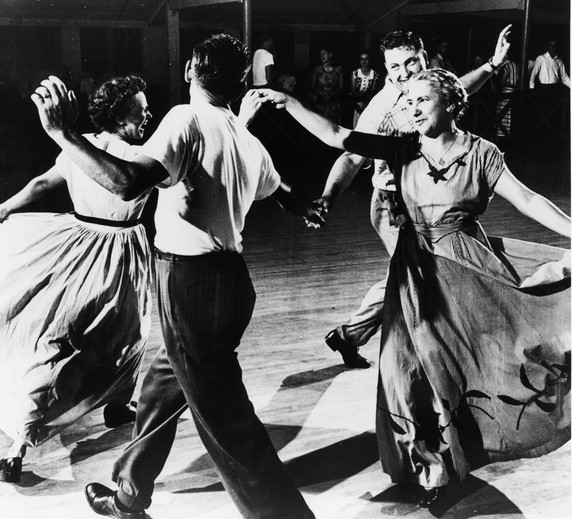
Square dancing has some basic moves that beginners learn. And so it was that Paula and I started with the basics. But in square dancing there are different levels, and so eventually we cleared the floor and watched those who knew the more advanced moves. Sometimes there were several levels of dancers. I remember being amazed at the complicated moves the move senior members had learned and wondered how I would ever master it. But, little by little the moves were learned, and we got to stay on the floor just a little longer as the months and years ticked by.
Image of the Church? I was over at YouTube and came upon the video below of a square dance group that’s pretty advanced. I remember many of the moves they do, but some of it was above what I ever learned. And suddenly it occurred to me that I saw an image of the Church.
Surely as a young man I never gave a thought to the Church, in terms of square dancing. But now with this great love for God and for the Church, I can’t help it, I see the Church in square dancing. Just a few thoughts:
1. Every Square Dance needs a caller and, if the dancers in the square are the body, he is the head. He calls the moves, and the dancers must listen and respond. He has the authority to set direction and maintain order. If a square falls into disorder he reestablishes order by calling them home. Not only that, it is also the role of the Caller to teach new moves and drill the dancers until they master it. So the caller is the source for unity and direction for the square.
This is also the role of the Pope and the Local Bishop in the Church who also have the authority to set direction, maintain unity and restore order when necessary. It is also their role to teach the faith, along with their priests and catechists until the faithful master the Christian walk (dance).
 2. As long as everyone listens carefully, and fulfills their particular role in the particular moves, the dance continues. But when, usually through error, one or more of the dancers veers away from the directed move, the square either stumbles or falls apart. As long as the dancers are open to learn, the square will continue to get better, and become a good, and disciplined group who increasingly enjoy advanced square dancing.
So too with the Church. When all listen carefully and do their part, the Church is strong and well ordered. When the faithful do not listen, or persist in error, the Church stumbles and is less effective. Disunity leads to a poor Christian walk (dance), not only for individuals, but also for groups and parishes. But if the faithful are willing to learn to and grow, the dance of faith becomes deeper and richer, more enjoyable, and just plain fun.
3. Everyone has a role, but not the same. When the caller calls a dance move, what you do in response depends on where you are in the square at that time. You might just stand still while others move, or you might be the one who switches positions. And all this varies from move to move.
And so it is with the Church. We have varied and different roles depending on where we are in the Church. Some of our roles are stable but others change depending on the situation. As a pastor, I am a leader and teacher in my parish. But at a meeting with the bishop I am a learner and a man under authority. In the parish I may take the lead when it comes to teaching the faith, but I may need to learn from my parishioners when it comes to understanding some technical legal matter, or car repair, etc. In such cases many of my parishioners can show me the way. We all have different gifts and talents and they all interact in various ways, depending on the situation. At times we lead, at times we follow, at times we stand still, while others move about us. All at the direction of the caller.
 4. There is an etiquette to square dancing. There are bows, and curtseys, there’s a way you hold a lady’s hand, and there is a graciousness expected by all. Especially for those in higher levels, proper attire is also expected. Timeliness is also important since it is necessary to have eight people to form a square and get things underway. Thus everyone needs to be committed and timely. If just one of the eight is late, seven others are left standing. In larger groups, where there are numerous squares, people can mix and match a bit, but one missing member always impacts many other people.
In the Church too, basic kindness and generosity are also expected and necessary. Where there is Charity and truth, God himself is there. Further, people must be true to their commitments and be timely or many others suffer.
5. There is a great intricacy to square dancing where many aspects are interacting at once. It is almost mind-boggling to watch as the dance unfolds.
So too with the Church, there are many layers and great intricacy at work. Some are praying, some are studying, some are raising children, some are preaching, some are evangelizing, some are caring for the poor, some are praying in front of abortion clinics. But all are responding to the great call of the Shepherd Jesus speaking through his Pope and Bishops, through the Scriptures and the Tradition. It is a great dance of wonderful intricacy, and everyone interacts at different levels, all at once.
So there you have it: the Church as a square dance. Enter the dance, learn the moves and have a great time.
This video shows Square Dancing at a more advanced level. I got close to this, but never this good. Paula’s parents could have danced like this in their sleep.
Please ignore the ad that I cannot avoid with this embedding! Yuch to ads! Please note that the ads change and some are quite graphic.
Please ignore the ad that I cannot avoid with this embedding! Yuch to ads! Please note that the ads change and some are quite graphic.


