Showing posts with label Parenting. Show all posts

Saturday, January 22, 2011

Revolutionary Parenting & the 7 Rs

This is part of an article by Theresa Thomas. You can read the complete article here.
I think there is a danger in thinking that a person is “done” at 18, that a child is “raised well” (or not) by then. After all, which of us is totally complete, finally the person God calls us to be even before we hit the second decade age mark? Moving towards God and towards heaven takes an entire life’s work. In the early years, parents are critical in launching the child in this direction. Later on, the decision, responsibility and privilege will be his own.  But it is a process, and we have to remember that.
That being said, what should good parents know in order to raise their children well in the Faith?  And what should parents do?

What Parents Should Know
Knowing several things will help Catholic parents navigate the exciting world of raising their children well. First, parents should know that the world, generally, will not support their efforts to raise their children in the Catholic faith. That’s not being negative. It’s stating a fact, which is also nothing new.

Since the time Jesus walked the earth Christian beliefs and Christians themselves have been persecuted. We need to arm ourselves with a joyful demeanor and live the Christian live fully without expecting it to be easy or to be applauded.

The world will frequently contradict our desires to be modest, chaste, kind, generous, patient, temperate, and holy. We must be modest, chaste, kind, generous, patient, temperate and holy anyway.

The world will tell us to pursue materialism, earthly goods, fame, power, “success”.  We must reject that and reach for higher goals, and teach our children to do the same. We have to expect to be revolutionaries, of sorts, radically living in peace, for Christ. And remember, revolutionaries don’t necessarily have support groups.

Yes, there may be pockets here and there of support, of like-minded people who are striving to raise their children the way that we are, and finding these folks will be blessed relief and consolation, like cold water is to a thirsty soul. Indeed, we should seek out like-minded parents to network and brainstorm with them, but we must not expect to rely on them in all cases, at all times. God alone will be our perfect strength as we seek to do His will, well, in our families.

Second, parents should also know that children learn far more from example than preaching or formal lessons. The best way we can raise good Catholic children is to be good Catholic people ourselves. Children learn temperance by seeing us model that. They learn kindness of speech by seeing that exemplified in us. They learn to love the Mass and sacraments when we love the Mass and sacraments and bring them with us to experience them.
We don’t need to preach to the children the importance of praying the rosary, although sharing stories and the Church’s guidance in this regard is good. We need to give them little plastic rosaries when they are just toddlers and snuggle with them on our laps as we recite the mysteries and pray this prayer ourselves. Our Catholic faith must be totally and entirely integrated in our lives, both for our own good and so our children can absorb it.

Third, parents should know that perseverance is essential because suffering often comes with the territory of raising children. This can be difficult to understand when one in the midst of it, especially at the beginning. We might initially address child-raising like we have other ‘projects’- We make a plan. We give our best efforts.  We expect immediate positive results because we have tried so hard and done our research.
Yet, raising good Catholic children is not like any other “project”. It takes more time, more faith, more trust than anything else we have ever done. Sometimes situations arise in child-rearing that challenge us to the very core of ourselves and elicit suffering, sometimes great suffering. This is perfectly normal. You see, God molds us as we mold our children. These are “growing pains”, of sorts. The growth toward holiness , in fact should,  be a family endeavor.  If we stay close to Him we have nothing to fear and are assured of “success,” in His time, in His way.

One day when I was at Mass, I suddenly and surely felt that a distinct part of the vocation of mothers is to suffer for their children. I sincerely believe that when we unite our daily sufferings to those of Jesus on the cross, our suffering can be redemptive. Our children may be buoyed by our generosity and spirit of acceptance when they would otherwise be tempted to falter just by our offering our sufferings for them.

The more children we have the more prayers we ought to be offering, and the more willing we ought to be to accept life’s little and big crosses for them. Our children’s eternal salvation may depend on it. I can’t help but think of good St. Monica who followed her selfish and sinful son to Rome, and then to Milan, literally hounding him with prayers. It is said that a bishop once said to a distraught Monica, “Surely a son of so many tears and prayers will not be lost.”
And we all know the outcome of that story- St. Monica became a great saint, as did her son St. Augustine, who was also named a Doctor of the Church.  We would all do well to emulate the example of Saint Monica and be relentless prayer warriors for our children.

What Parents Should Do
There is no formula for raising good Catholic children into good Catholic adults, but we can utilize a strategy that many parents have discovered and which really isn’t that complicated.

It is best remembered by thinking of the seven Rs: Receive, Read, Remember, Remain, Rely, Rejoice, Relax.

-Receive the sacraments soon and frequently. This cannot be emphasized enough. Baptize babies immediately. If Aunt Martha can’t make it for two months to see the baby, go ahead and throw the baptismal party when it’s convenient for her, but don’t postpone the sacrament to fit her or anyone’s schedule. It is most important that the child receive his baptism as soon as possible after birth. It is less important that mom is up for visitors, and more important that the baby enter the Church. On a similar note, make a family confession date every single month. Some families like to go out for ice cream afterwards or plan another little treat. The sacrament of confession is critical for the spiritual growth of everyone. We wouldn’t dream of going months without showering, which cleanses our bodies, so why should we consider going more than a month without Confession, which cleanses our souls? Last, we should take the children to Mass more than once a week on Sunday. An entire book can be written why, but suffice it to say here they will grow spiritually, learn how to better behave and we mothers will reap benefits as well.

-Read to your child. Start with simple toddler bible stories when they are small, then move on to other Catholic board books and short stories which teach the Faith in simple terms. Incorporate these into evening story time. As your child grows older, add the “real” bible, the catechism, enriching words from all sources. Take the time to teach your children simple apologetics. The complexity of the apologetics books chosen can grow with your child’s age and wisdom.  Snuggling on the sofa with a good book and your child can be bonding like few things are, and will help your child grow in Faith if you choose the right reading.

-Remember that you are not alone. Your spouse is your partner in raising your child in the Faith. Daddies offer perspectives and wisdom that mommies can’t, simply because they are men and we are not. Be a team player and be open to your spouse’s ideas and suggestions.

-Remain steadfast. Endure. My husband is a golfer. He relates to life on a sport’s level. He recently put it this way: “I can control my swing and mindset  on the golf course, but not the weather. It may rain. The wind may blow. I can’t control that. But I tee up the ball with the proper mindset and orchestrate the mechanics of my swing the best I can. I think positively and keep moving forward.” Life is not a game of golf, but the idea of controlling what we can and trusting the rest to God is a good plan.

-Rely on God’s good graces. Trust Him.

-Rejoice. Be thankful. Enjoy each moment, each stage and yes, each challenge. As we strive to raise our children well we will see personal growth too. God is so good.

-Relax.  Give yourself a break when you need one, and find ways to spiritually re-charge. Attend a bible study at your parish alone, take time for personal prayer, or meet a like-minded friend for lunch and exchange of ideas. Try hard but don’t expect perfection right off the bat. If you falter, forgive yourself and get up and try again. Remember a fool sits enjoying a mud puddle, but an equal fool may recognize his situation yet sits and laments his fate in the puddle without trying to get out. A wise person recognizes when she is deep “in the mud”, gets up, wipes herself off (Confession) and tries again, careful to avoid the puddle the next time.

An eighth “R” might also be to recognize that “success” is not measured by external cues alone. God works in mysterious ways in the deep recesses of the human soul. He is working on our children as He is working on us.  Trust Him.

SOURCE:  What Every Mother Needs to Know About Raising Catholic Kids

Tuesday, March 4, 2008

A New Ministry

For all who might be a bit frustrated that they can't get out more often to serve the Church, an invitation I found (see link at end of post):

You are invited to join a new ministry called Missionaries in the Home. The time commitment requires every minute of every day (and night) for a term of at least the next 18 years and may be extended at any time depending on the birth of new little Christians who need evangelization. The responsibilities include feeding the hungry, clothing the naked, caring for the sick, visiting with the lonely, catechizing, and educating, as well as all the support services, transportation, maintenance duties, and financial support for the position and all those who fall under the scope of the ministry.

Our goal is simple, to build the Kingdom of God through the co-creation and formation of new members within our own households. The ministry will have to be an underground operation, however, as the world will reject the importance of such an undertaking, and my husband has forbidden me from approaching our pastor for formal recognition. Please join me in this invaluable work for the Church. I think you'll be able to fit it into your already busy schedule without noticing a difference.

source: Justinespired

Thursday, February 14, 2008

Boyfriends and Girlfriends

I find that, more and more, children are drawing the unfortunate conclusion that when boys and girls like each other they must be labeled boyfriend and girlfriend. What is really discouraging is that this is often the result of the encouragement and prodding of adults who think it is “cute.”

It is also disheartening that this leads to kids who never do learn to have that wonderful, rare and precious thing -- a friend who is the opposite gender.

I have seen this happen so many times – even with children as young as 3 & 4 years old. I just do not get it . . . . What is so cute about attributing romantic adult characteristics to our children's innocent and purely loving friendships?

Just yesterday a neighbor told me (in front of her 5 year old Austin),

Oh yes, Austin has a little girlfriend in class! It's so cute. They are going to the movies together on Saturday. Her Mom and I worked out a play date. He thinks she is beautiful!”

I'm sorry but I wanted to throw up. I opted for the “totally ignore the connotations and respond as if I am oblivious” response.

I think I said something like, “Isn't that great that Austin has such a good friend in kindergarten. Going to the movies is always fun, the more the merrier...are you inviting any of the neighborhood kids?”

Rude? Maybe...but it stopped me from preaching at her and I am sure that would have just made her mad and made me look like some “know-it-all” because of my strong opinion in this matter.

I have noticed that many times the same parents who wring their hands over promiscuous teenagers and teens who have "serious" romantic relationships are often the same ones who encourage puppy love in kindergarten.

Sunday, January 6, 2008

Happiness Comes From Humility, Service & Purpose


This is a small part of a great interview found at Zenit. Author and teen-health expert Doctor Meg Meeker is being interviewed. Meeker has practiced pediatric and adolescent medicine, as well as teen counseling. She has written a book entitled, "Strong Fathers, Strong Daughters: 10 Secrets Every Father Should Know," by Regnery Publishing.

Meeker: One of the greatest mistakes that parents make in their kids is a misunderstanding of what happiness and joy is in their kids. Parents just want their kids to be happy, but they perceive incorrectly that it comes from receiving pleasure, so when children receive, receive, receive, happiness does not come, resulting in a lot of unhappy kids.
Despite our material wealth, depression rates have never been so high. Clearly we are missing something. Parents
have been duped. What works is when we teach kids to serve, to look beyond themselves. Real joy and happiness comes when kids understand that they have a purpose in life, and a mission to fulfill. The only way to get them to understand this is to look beyond self and doing good for others.
This is the source of real transformation, but this can't happen without humility, the opposite of which is pride. When parents instill humility, a kid understands that he or she is important, and lovable, but not separate from others in their humanity. If a kid really wants to feel good about himself, humility brings people closer, whereas pride separates.
A kid raised without humility will always strive to be better than others, smarter than others, but can only bring a frustrated "happiness" because no one can always be the best at everything.
True happiness for kids, then, is to give them a purpose to fulfill through working, striving,
giving to and for others.

Wednesday, November 14, 2007

What Kind of Mini-World Are You Creating?


A young mother was having one of the worst days of her life. Her husband lost his job the water heater exploded and the postman brought a stack of bills she couldn't pay. Her hair was a mess, and she felt fat and ugly. She was almost at the breaking point as she lifted her little one-year-old into his highchair, leaned her head against the tray and began to cry. Without a murmur, the little one took the pacifier out of his own mouth ... and gently placed it in hers!


Compassion and Generosity: He didn't know the words, but his heart knew the need. And he gave what he had! In so many ways, we are the makers of one another's worlds. Minute by minute, we create the mini-world we live in together. And most of the time, we haven't a clue as to how huge is our power to bring joy or sorrow, healing or injury to one another.
For example, together, at this very moment, we are creating a short-lived little world. We do that in countless little ways: By the way we come in and the way we leave, the way we respond to each other and the way we pray together, the way we make room for one another.
From the moment we open our eyes in the morning till we close them at night, we have the power to create and the power to destroy We have the power to give our gifts -- large and small -- and the power to withhold them.
Most of us will rarely be called upon to make a truly huge sacrifice for another. But all of us will encounter thousands of people whose lives we can make a little richer, a little happier because we were there and because we gave what we had -- just like that little tyke who gave away his pacifier.
At every moment, each of us has something to give, something that's needed. Will we give it? We simply must, because giving our gifts is the only way we'll ever find happiness. It is a beautiful way to grow into the image and likeness of God.

Dt 30:10-14 / Col 1:15-20 / Lk 10:25-37
sources:

Monday, November 5, 2007

Mum2Twelve

There is a wonderful post over at Mum2Twelve.

It is called One at a Time. I found it via AWTY.

The Catholic Mom blog-o-sphere is quite lovely. I have found it to be a grounded, family focused, strong group of woman.

I would like to know what my 7th graders think after reading this post. Come back here . . . to Catholic Notebook and reply.
(Please note: eldest child missing from this picture - photo credit Paul Tomas, to see his work click here. )

Saturday, November 3, 2007

Partial Interview with P.Pullman; The Golden Compass


Here is a portion of an interview KidsReads did with Philip Pullman. Pullman is the author of a Random House children's book Scholastic is selling called, The Golden Compass.

Bolding
is, as usual, my emphasis. Go ahead and read it; I already have -- I am leaving now because it made me sick to my stomach. More posts later.

KidsReads Interviewer:
Why are all witches are female? Why are dæmons usually the opposite gender of their human counterparts? Is the fact that Lyra is a girl-child relevant to the themes HIS DARK MATERIALS?

Philip Pullman:
Daemons are usually the opposite sex because we each have a bit of the opposite in our make-up, and it was one way of making that visible. Witches are female because they are --- that's the way it is. Some of their powers can be acquired by men, though, as Will inadvertently discovers, but only at the cost of suffering as witches themselves have to. As for Lyra, as soon as I thought of her I knew she had to meet Will. The two of them go through it all together, and it's vital that they come to realise their love together. The theme of the whole thing, after all, is the ending of innocence and the beginning of wisdom; and that is summed up in the third chapter of the Book of Genesis, which is the origin of this and PARADISE LOST and many other stories, in the story of Adam and Eve. Lyra is Eve; Mary Malone is the serpent, who teaches her how to fall in love, and Will is Adam.

Tuesday, October 30, 2007

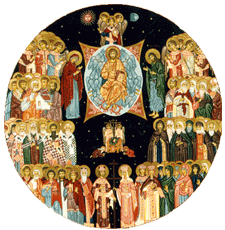
Celebrating All Saints Day & All Soul's Day


When The Church came to a new culture to teach and convert, the missionaries strove to take native celebrations and convert their meanings and subtly adapt their trappings to Christian themes. They purposely placed Church holidays around the approximate times of important events in the life of Christ, but also to coincide with nonchristian celebrations they wished to replace. And they were almost universally successful in this quest.

The institution of the Feast of All Hallows, or All Saints,was an attempt to replace the Roman feast of the dead, Feralia. But, the customs most commonly associated with the celebration of this holiday in the modern world are Gaelic in nature, a passdown from the druids.

Hat tip to: Are We There Yet for this information. Read the whole post here.

Two important feast days are quickly approaching. I thought I would share a post that I found at Radical Catholic Mom (love that blog!). Her ideas are wonderful. I have added our family traditions in red.

November 1: Feast Day of All Saints. On this day the Church celebrates all of the brilliant and not so brilliant people who loved God so much they chose Him over all else. They loved him so much they became Holy like Him and during their lives their holiness could be seen by others. Think Mother Teresa, Francis, Gianna Molla, Anthony, the Apostles, Mary, etc. This is a Holy Day of Obligation so the first thing we do is make sure we attend Mass during the day or evening. Sadly, we notice less and less people even bother to attend so make sure this is priority number one! In my home, we have saint pictures, statues throughout the house and we always ask their intercession during our morning and evening prayers so in a way we love our Saints throughout the year.

We have Mass at school followed by a parade of Saints. The kids dress as one of their favorite Saints -- or in my son's case -- the one his teacher assigned. Here is that story!! :-)

He was all set to be St. Michael -- ever since last year he has been looking forward to "being St. Michael "! We've read about St. Michael, started putting together the St Michael costume and my little guy was very excited. Alas, the teacher assigned saints. My little guy is St. Benedict. My son is very adaptable and optimistic... he accepted this change with little problem but he told me he was disappointed. He has now spent time learning a lot about two different Saints. This is wonderful in my eyes. He is still St. Michael around the house though.

After school we go to our parish for Mass and another Saint parade. There will be no time to change clothes so mi hijo will represent St Benedict again. We are excited about the timing this year -- being able to celebrate at school and at our parish.

November 2: The Feast Day of All Souls. Not a Holy Day of Obligation, but my family ALWAYS attends Mass on this very important day. In Mexican culture this is the Day of the Dead and we celebrate the Day of the Dead in my home and at Mass. Since I am not Mexican, I have adopted part of the practices only. I don't make the bread or the sugar skulls, but we have adopted the idea. We place pictures or mementos of our beloved dead--grandparents, Mother-in-Law, miscarried baby, other family, a list of names etc--and make an altar in our living room. The altar has a memorial candle (the long tall ones with a saint face on it), I leave the candle unlit because I have a toddler, I only light it during our prayer service. Along with the candle I place all the mementos and pictures of our dead family members and we pray for them and all souls in Purgatory. In the evening we attend Mass and carry along our pictures to place at the altar.
What I love about these two special days of the year, is that it connects the living with the dead. We will tell stories about our dead family members, members my daughter does not know, and in this way we pray for them and continue family traditions and stories. Oh, at the altar we also sing songs during our family service. We tend to sing in Spanish, so we choose Resucito (He is Risen) or Alabare, something joyous for the occasion.

Radical Catholic Mom has a great family tradition going on here! My husband and I are going to model our day after her family's. Thank you! Isn't the Internet great? I have learned so much from others in the community of Catholic blogs.

All Soul's Day in the Philippines

all saints day


All Soul's Day in Poland

Monday, October 29, 2007

Our Fast Food Incident


The onus lies on parents to educate their children about the ill effects of fast food.”

This is a quote from my latest entry on fast food.

In our family fast food is not part of our diet. This choice has evolved in our family. We all have made this commitment both individually and as a family.

The reasons start with the abuse of meat packing plant workers; the exploitation of immigrants who are working in THE most dangerous work in any American plant. The reasons continue because of


  • the poor quality of fast food

  • The fecal matter in hamburgers

  • the hormones, chemicals and anti-biotics in the food

  • the greed of the major fast food decision makers

  • the inhuman treatment of animals raised and slaughtered for America's gluttony

  • the high fat content

Because of our family commitment I, certainly cannot condone fast food -- especially as a “treat”.

We recently had a “situation” where a child's parent in my son's class brought McDonalds to all the kids as a treat in celebration of her son's birthday. Whatever happened to the old fashioned birthday party? ---->
  • cake and ice cream
  • pin the tail on the donkey
  • drop clothespin in the milk bottle
  • wheel barrow races

When we have one everyone raves at how cool it is. "Retro" is in guys! The kids have a blast, the parents kick back and relax and sometimes even play with their kids.

Anyway, the parent was taking "McDonalds orders" and my son raised his hand to say that we do not eat McDonalds could he just have his regular lunch. My son really likes this little guy whose birthday brought about this situation. He did not want to hurt his feelings but he knew our commitment. I do not think the teacher understood our stance on this issue. She told my son, "I will talk to your mother." I think she may have been a little perturbed at my solid, “No.” She mentioned how this was a special occasion and seemed put off that my son would be the “different” one. She alluded to the feelings of the parent and how the parent would not want to leave my son out of the special treat.

Special Treat? And that was supposed to make it ok? That would be elevating fast food to a special status – something to be looked forward to or viewed as some kind of treat of celebratory food.

If you've made a commitment – you keep that commitment.

Further, if it is bad for you – it is bad for you.

If giving money to fast food companies contributes to putting people in danger or in exploiting them – it does that even if we only SOMETIMES “eat McDonalds”.

Yes, the onus lies on parents to educate their children about the ill effects of fast food.

And now I know that it is soley in our family's hands. We will get no support from our son's teacher or school. What a shame.

Just a note -- My son wasn't complaining.

----------------------------------------------------------------------------------------------

Portion of source article:

photo of schlosserinterview: eric schlosser

Where does hamburger come from?

Hamburger comes from cattle. The cattle start on ranches, and then are sold to feedlots. And the feedlots aren't small little operations with 30 to 40 cattle in them. They're enormous, and can have up to 100,000 cattle in a single feedlot.

This has huge implications for food safety, because these cattle are often living like in a medieval city, in their own manure. From the feedlot, they'll get shipped to the slaughterhouse, processed into smaller cuts of meat, and then go to the grinder -- many slaughterhouses have a grinder right nearby -- and then go into further processing at a patty plant. Then they'll be at the fast-food restaurant, from the patty plant. ...

. . . .There a couple of problems when it comes to contamination of the meat. Some of it is visible manure on the meat. The other problem is the invisible aerosoled manure that is spread everywhere.

Let's talk specifically about the packers and the role that they play. You talked about the power of the fast-food companies. I think people in general don't understand the dynamics of the meat industry and how it's segregated. Who are the big players on the block? Who are the ones that really control the meat industry?

There are really three companies that control the beef industry in the United States. Excel, which is a subsidiary of the huge agribusiness company Cargill. ConAgra, another huge agribusiness company. And Tyson IBP, which is the biggest meatpacking company the world has ever seen. These three companies are the heart of the American meatpacking industry.

How powerful are they?

They're very, very powerful. If you're a rancher or if you're a consumer, these three companies have an enormous impact on the sale of cattle and on the meat that's being purchased. ...

-------------------------------------------------------------------------------------------------------------

Portion of another source article: "Battling Food-Poisoning Bacteria":

"Public concern over E. coli O157:H7 has skyrocketed since 1993, when the microbe—in undercooked hamburger patties—killed four children in the Pacific Northwest. In that single outbreak, 477 people were infected from the undercooked, contaminated hamburger.

Foodborne disease-causing bacteria such as E. coli O157:H7 are found in feces and spread to food through fecal contamination. One of the prime ways to reduce bacterial contamination is to reduce fecal contamination in livestock and poultry slaughter facilities. Current federal regulations mandate zero tolerance for visible fecal contamination and for E. coli O157:H7.

At the slaughterhouse, visual inspections and carcass cleaning have been two of the standard tools for reducing the likelihood of E. coli and other bacterial contaminants in meat.

But 'the human eye is not very sensitive and often can't tell the difference between feces and blood clots that can be on a carcass,' says ARS microbiologist Mark A. Rasmussen at Ames."

"Battling Food-Poisoning Bacteria" was published in the February 1999 issue of Agricultural Research magazine.

------------------------------------------------------------------------------------------------------

Can you handle some more??

In this article for Mother Jones magazine, Eric Schlosser, author of Fast Food Nation, details the often brutal economics of working in today's meatpacking plants. "Over the past four years," Schlosser writes, "I've met scores of meatpacking workers in Nebraska, Colorado, and Texas who tell stories of being injured and then discarded by their employers." Schlosser explains why the current system -- in which some plants slaughter cattle at a rate of 400 per hour -- is less secure for the workers, both physically and economically. "A lack of public awareness, a lack of outrage, have allowed these abuses to continue, one after another, with a machine-like efficiency. This chain must be stopped."

Blog Widget by LinkWithin