Showing posts with label Archdiocese of Washington. Show all posts

Friday, June 8, 2018

Beware the “Soloists”

Msgr. Charles Pope hits the nail on the head once again . . . and with such an edifying and eloquent analogy! I must also mention that his play on words about "singing solo" is wonderful! This well organized, easy to read, article is a "saver" for sure. The bolded RED words are my emphasis. I have also included my crib notes or "take-aways" at the end of this post.
Beware the “Soloists”  A Concern for the Protestant “Solos”: Sola Fide, Sola Scriptura, Sola Gratia  • June 7, 2018
There are a lot of “solos” sung by our Protestant brethren: 
1) sola fide (saved by faith alone) 
2) sola gratis (grace alone 
3) sola Scriptura (Scripture alone is the rule of faith)
Generally, one ought to be leery of claims that things work “alone.” Typically, many things work together in harmony; things are interrelated. Very seldom is anyone or anything really “alone.”

The problem with “solos” emerges (it seems to me) in our mind, where it is possible to separate things out; but just because we can separate something out in our mind does not mean that we can do so in reality.

Consider, for a moment, a candle’s flame. In my mind, I can separate the heat of the flame from its light, but I could never put a knife into the flame and put the heat of the flame on one side of it and the light on the other. In reality, the heat and light are inseparable—so together as to be one.

I would like to argue that it is the same with things like faith and works, grace and transformation, Scripture and the Church. We can separate all these things out in our mind, but in reality, they are one. Attempting to separate them from what they belong to leads to grave distortions and to the thing in question no longer being what it is claimed to be. Rather, it becomes an abstraction that exists only on a blackboard or in the mind of a theologian.
Let’s look at the three main “solos” of Protestant theology. I am aware that there are non-Catholic readers of this blog, so please understand that my objections are made with respect. I am also aware that in a short blog I may oversimplify, and thus I welcome additions, clarifications, etc. in the comments section.

Solo 1: Faith alone (sola fide) – For 400 years, Catholics and Protestants have debated the question of faith and works. In this matter, we must each avoid caricaturing the other’s position. Catholics do not and never have taught that we are saved by works. For Heaven’s sake, we baptize infants! We fought off the Pelagians. But neither do Protestants mean by “faith” a purely intellectual acceptance of the existence of God, as many Catholics think that they do.
What concerns us here is the detachment of faith from works that the phrase “faith alone” implies. Let me ask, what is faith without works? Can you point to it? Is it visible? Introduce me to someone who has real faith but no works. I don’t think one can be found. About the only example I can think of is a baptized infant, but that’s a Catholic thing! Most Baptists and Evangelicals who sing the solos reject infant baptism. 
Hence it seems that faith alone is something of an abstraction. Faith is something that can only be separated from works in our minds. If faith is a transformative relationship with Jesus Christ, we cannot enter into that relationship while remaining unchanged. This change affects our behavior, our works. Even in the case of infants, it is possible to argue that they are changed and do have “works”; it’s just that they are not easily observed. 
Scripture affirms that faith is never alone, that such a concept is an abstraction.
Faith without works is dead (James 2:26). Faith without works is not faith at all because faith does not exist by itself; it is always present with and causes works through love.  
Galatians 5:6 says, For in Christ Jesus neither circumcision availeth anything, nor uncircumcision; but faith working through love.Hence faith works not alone but through love.  
Further, as Paul states in 1 Corinthians 13:2, if I have all faith so as to move mountains but do not have love, I am nothing.Hence faith alone is the null set. True faith is never alone; it bears the fruit of love and the works of holiness. Faith ignites love and works through it. Beware of the solo “faith alone” and ask where faith, all by itself, can be found.
Solo 2: Grace alone (sola gratia) – By its very nature grace changes us. Again, show me grace apart from works. Grace without works is an abstraction. It cannot be found apart from its effects. In our mind it may exist as an idea, but in reality, grace is never alone.
Grace builds on nature and transforms it. It engages the person who responds to its urges and gifts. If grace is real, it will have its effects and cannot be found alone or apart from works. It cannot be found apart from a real flesh-and-blood human who is manifesting its effects.
Solo 3: Scripture alone (sola Scriptura) – Beware those who say, “sola Scriptura!” This is the claim that Scripture alone is the measure of faith and the sole authority for the Christian, that there is no need for a Church and no authority in the Church, that there is only authority in the Scripture.
There are several problems with this.
First, Scripture as we know it (with the full New Testament) was not fully assembled and agreed upon until the 4th century.
It was Catholic bishops, in union with the Pope, who made the decision as to which books belonged in the Bible. The early Christians could not possibly have lived by sola scriptura because the Scriptures were not even fully written in the earliest years. And although collected and largely completed in written form by 100 AD, the set of books and letters that actually made up the New Testament was not agreed upon until the 4th century.
Second, until recently most people could not read.
Given this, it seems strange that God would make, as the sole rule of faith, a book that people had to read on their own. Even today, large numbers of people in the world cannot read well. Hence, Scripture was not necessarily a read text, but rather one that most people heard and experienced in and with the Church through her preaching, liturgy, art, architecture, stained glass, passion plays, and so forth.
Third, and most important, if all you have is a book, then that book needs to be interpreted accurately.
Without a valid and recognized interpreter, the book can serve to divide more than to unite. Is this not the experience of Protestantism, which now has tens of thousands of denominations all claiming to read the same Bible but interpreting it in rather different manners?
The problem is, if no one is Pope then everyone is Pope! Protestant “soloists” claim that anyone, alone with a Bible and the Holy Spirit, can authentically interpret Scripture. Well then, why does the Holy Spirit tell some people that baptism is necessary for salvation and others that it is not necessary? Why does the Holy Spirit tell some that the Eucharist really is Christ’s Body and Blood and others that it is only a symbol? Why does the Holy Spirit say to some Protestants, “Once saved, always saved” and to others, “No”?
So, it seems clear that Scripture is not meant to be alone. Scripture itself says this in 2 Peter 3:16: 
 . . . our beloved brother Paul, according to the wisdom given to him, also wrote to you, Our Brother Paul speaking of these things [the Last things] as he does in all his letters. In them there are some things hard to understand that the ignorant and unstable distort to their own destruction, just as they do the other scriptures. 
Hence Scripture itself warns that it is quite possible to misinterpret Scripture.
Where is the truth to be found? The Scriptures once again answer this: you should know how to behave in the household of God, which is the church of the living God, the pillar and foundation of truth (1 Tim 3:15).
Hence Scripture is not to be read alone. It is a document of the Lord through the Church and must be read in the context of the Church and with the Church’s authoritative interpretation and Tradition. As this passage from Timothy says, the Church is the pillar and foundation of truth. The Bible is a Church book and thus is not meant to be read apart from the Church that received the authority to publish it from God Himself. Scripture is the most authoritative and precious document of the Church, but it emanates from the Church’s Tradition and must be understood in the light of it.
Thus, the problems of “singing solo” seem to boil down to the fact that if we separate what God has joined we end up with an abstraction, something that exists only in the mind but in reality, cannot be found alone.
Here is a brief video in which Fr. Robert Barron ponders the Protestant point of view that every baptized Christian has the right to authoritatively interpret the Word of God.


Some quick "take-aways" for me:
Attempting to separate them (the 'solos') from what they belong to leads to grave distortions and to the thing in question no longer being what it is claimed to be. Rather, it becomes an abstraction that exists only on a blackboard or in the mind of a theologian.
SOLA FIDE: faith alone is the null set 
SOLA GRATIA:  By its very nature grace changes us. Again, show me grace apart from works. Grace without works is an abstraction. It cannot be found apart from its effects. 
SOLA SCRIPTURA: It was Catholic bishops, in union with the Pope, who made the decision as to which books belonged in the Bible. The early Christians could not possibly have lived by sola scriptura because the Scriptures were not even fully written in the earliest years. 
Until recently most people could not read. Given this, it seems strange that God would make, as the sole rule of faith, a book that people had to read on their own. Even today, large numbers of people in the world cannot read well.  
If all you have is a book, then that book needs to be interpreted accurately. If no one is Pope then everyone is Pope! 
Scripture itself says that it is not meant to be alone. 2 Peter 3:16
You should know how to behave in the household of God, which is the church of the living God, the pillar and foundation of truth (1 Tim 3:15). Read it again . . . and what is the pillar and foundation of truth? The church!
Thus, the problems of “singing solo” seem to boil down to the fact that if we separate what God has joined we end up with an abstraction, something that exists only in the mind but in reality, cannot be found alone. 

http://blog.adw.org/2018/06/beware-soloists-concern-protestant-solos-sola-fide-sola-scriptura-sola-gratia/

Tuesday, January 22, 2013

Square Dance Metaphor

This is a great article by Msgr. Charles Pope

An easy read and a cool metaphor. If you know me, you know I love the Church, a good metaphor, dance and kaleidoscopes . . . . this brings it all together (especially if you see the kaleidoscope in square dancing).


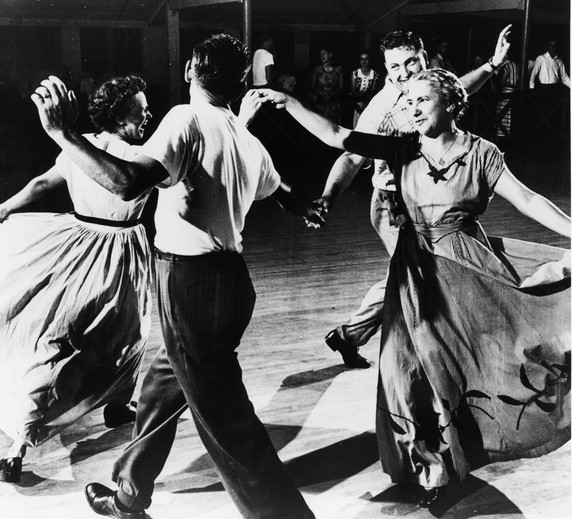
Years ago, in High School, I dated Paula, who liked square dancing. So, most Saturday nights we were down at the community center, she in her petticoats and dress, I in my jeans, button down western shirt with a scarf tie and hand towel.
Square dancing has some basic moves that beginners learn. And so it was that Paula and I started with the basics. But in square dancing there are different levels, and so eventually we cleared the floor and watched those who knew the more advanced moves. Sometimes there were several levels of dancers. I remember being amazed at the complicated moves the move senior members had learned and wondered how I would ever master it. But, little by little the moves were learned, and we got to stay on the floor just a little longer as the months and years ticked by.
Image of the Church? I was over at YouTube and came upon the video below of a square dance group that’s pretty advanced. I remember many of the moves they do, but some of it was above what I ever learned. And suddenly it occurred to me that I saw an image of the Church.
Surely as a young man I never gave a thought to the Church, in terms of square dancing. But now with this great love for God and for the Church, I can’t help it, I see the Church in square dancing. Just a few thoughts:
1. Every Square Dance needs a caller and, if the dancers in the square are the body, he is the head. He calls the moves, and the dancers must listen and respond. He has the authority to set direction and maintain order. If a square falls into disorder he reestablishes order by calling them home. Not only that, it is also the role of the Caller to teach new moves and drill the dancers until they master it. So the caller is the source for unity and direction for the square.
This is also the role of the Pope and the Local Bishop in the Church who also have the authority to set direction, maintain unity and restore order when necessary. It is also their role to teach the faith, along with their priests and catechists until the faithful master the Christian walk (dance).
2. As long as everyone listens carefully, and fulfills their particular role in the particular moves, the dance continues. But when, usually through error, one or more of the dancers veers away from the directed move, the square either stumbles or falls apart. As long as the dancers are open to learn, the square will continue to get better, and become a good, and disciplined group who increasingly enjoy advanced square dancing.
So too with the Church. When all listen carefully and do their part, the Church is strong and well ordered. When the faithful do not listen, or persist in error, the Church stumbles and is less effective. Disunity leads to a poor Christian walk (dance), not only for individuals, but also for groups and parishes. But if the faithful are willing to learn to and grow, the dance of faith becomes deeper and richer, more enjoyable, and just plain fun.
3. Everyone has a role, but not the same. When the caller calls a dance move, what you do in response depends on where you are in the square at that time. You might just stand still while others move, or you might be the one who switches positions. And all this varies from move to move.
And so it is with the Church. We have varied and different roles depending on where we are in the Church. Some of our roles are stable but others change depending on the situation. As a pastor, I am a leader and teacher in my parish. But at a meeting with the bishop I am a learner and a man under authority. In the parish I may take the lead when it comes to teaching the faith, but I may need to learn from my parishioners when it comes to understanding some technical legal matter, or car repair, etc. In such cases many of my parishioners can show me the way. We all have different gifts and talents and they all interact in various ways, depending on the situation. At times we lead, at times we follow, at times we stand still, while others move about us. All at the direction of the caller.
4. There is an etiquette to square dancing. There are bows, and curtseys, there’s a way you hold a lady’s hand, and there is a graciousness expected by all. Especially for those in higher levels, proper attire is also expected. Timeliness is also important since it is necessary to have eight people to form a square and get things underway. Thus everyone needs to be committed and timely. If just one of the eight is late, seven others are left standing. In larger groups, where there are numerous squares, people can mix and match a bit, but one missing member always impacts many other people.
In the Church too, basic kindness and generosity are also expected and necessary. Where there is Charity and truth, God himself is there. Further, people must be true to their commitments and be timely or many others suffer.
5. There is a great intricacy to square dancing where many aspects are interacting at once. It is almost mind-boggling to watch as the dance unfolds.
So too with the Church, there are many layers and great intricacy at work. Some are praying, some are studying, some are raising children, some are preaching, some are evangelizing, some are caring for the poor, some are praying in front of abortion clinics. But all are responding to the great call of the Shepherd Jesus speaking through his Pope and Bishops, through the Scriptures and the Tradition. It is a great dance of wonderful intricacy, and everyone interacts at different levels, all at once.
So there you have it: the Church as a square dance. Enter the dance, learn the moves and have a great time.
This video shows Square Dancing at a more advanced level. I got close to this, but never this good. Paula’s parents could have danced like this in their sleep.

Please ignore the ad that I cannot avoid with this embedding! Yuch to ads! Please note that the ads change and some are quite graphic.


Sunday, March 21, 2010

Counting the Cost of Condemnation

Wonderful post from The Archdiocese of Washington blog. It is a keeper for my Catholic Notebook. This is a blog of note, folks. Add it to your blog roll and you will not be disappointed.


Counting the Cost of Condemnation
By: Msgr. Charles Pope
 
The Gospel for today’s Mass is the well known Gospel of the woman caught in adultery.  In this Gospel the Lord reasons with the men of his day (and with us) that the severe justice they want to render to this woman may be an unwise stance as they themselves prepare for their own judgment.    
Before we look any further at the details of this Gospel consider with me a few background texts that may help us to grasp better what Jesus is teaching. After each verse I will give a brief commentary.    
  1. Blessed are the merciful, for they will be shown mercy. (Matt 5:7) Notice here that it is the merciful who will obtain mercy. It is those who have shown proper mercy that will be granted mercy on the Day of judgment. By implication, the severe and those who lack mercy will be judged severely by the Lord.
  2. Do not condemn, and you will not be condemned. Forgive, and you will be forgiven. Give, and it will be given to you. A good measure, pressed down, shaken together and running over, will be poured into your lap. For with the measure you use, it will be measured to you.” (Luke 6:37-38) Here the text clearly states that if you or I use a severe standard of judgment, that same severe standard will be used by the Lord when he judges us. On the other hand if we are forgiving, merciful and generous then we can expect a merciful, generous and kind judgment from God.
  3. Speak and act as those who are going to be judged under the law of freedom, for  judgment without mercy will be shown to anyone who has not been merciful. Mercy triumphs over judgment! (James 2:12-13) Here too James warns us by reminding us first of all, that we are going to be judged  by the Lord. Secondly, since we are free we are therefore responsible for what we do. Thirdly, since we are going to face this judgment in which we cannot pass off blame to others for what we have freely done we’d better realize that our judgment will be without mercy if we have not shown mercy. Ah but if we have shown mercy we stand a chance for mercy will triumph over strict judgment.
  4. For if you forgive men when they sin against you, your heavenly Father will also forgive you. But if you do not forgive men their sins, your Father will not forgive your sins (Mat 6:14-15) This warning seems clear enough that if we want to find forgiveness on the day of judgment we had better seek the grace to forgive others.
All of these texts seem to teach a bold truth that we are actually able to influence the standard that the Lord will use on the day of our judgment. The measure we use for others will be measured back to us. If we have been merciful we will find mercy. But if we have been harsh, unbending, and unmerciful the Lord will use a far stricter standard by which to judge us. We need to be sober about this. We are storing up things for the day of judgment by the way we treat others. Now on to the Gospel.    
The teachers of the law and the Pharisees bring a woman caught in the very act of adultery. It is clear she is guilty of this offense. (However a curiosity exists. She was caught in the very act, so the man involved is also surely known. Where is he and why has he not be brought forward?  The Law of Moses also indicates that the man should be stoned). Now the accusers want to throw the book at her. They want the most strict punishment meted out. They want her stoned.   
     
Jesus who as God knows all their sins must be amazed. Surely they cannot be serious in demanding this if they consider the day of their own judgment?! He bends down and traces his finger on the ground almost as though his finger was tracing back and forth as he read what was recorded of them in the book.  So he tries to reason with them and says, 
Let him among you who is without sin cast the first stone!”  
Then he bends down again and continues tracing or writing on the ground. It is almost as though he were saying:   
“Reason with me men, if you demand strict justice, if you insist that I throw the book at her, let’s first look and see what there is about you in the book. If she is to be judged strictly and without mercy then you too will face the same standard you demand for her. There are things in the book about you, serious things. Have you counted the cost of condemning this woman? Are you sure you want to go on demanding that I throw the book at her? Think about it men.”    

One by one they go away starting with the oldest who are presumably less rash than the younger and may have more sins! Soon Jesus is alone with the woman. He does not condemn her but warns her not to commit this sin again.  

So the message for us is clear. We will face judgment. Sober about that fact we need to count the cost of our being unmerciful, unforgiving and vengeful. The measure that we use for others with be the measure God uses for us. What kind of judgment are you preparing for yourself?  Be careful to count the cost.   

It remains true that we must sometimes correct sinners and meet out punishment. Jesus is compassionate with this woman but he warns her not to sin again. Punishment is sometimes necessary and at times it falls to us to issue it. Perhaps we are a parent, a juror, or someone in a supervisory role. But before we rush to the most extreme measures we do well to show mercy and use lesser measures first. 
St. Paul has good advice: Brothers, if someone is caught in a sin, you who are spiritual should gently set him right. But watch yourself, or you also may be tempted  (Gal 6:1) Gentle and clear correction is the best course, more significant punishments should be a later recourse. We must be careful not to be tempted to harshness, anger, lack of mercy and lack of love.  

Count the cost. Condemnation comes at a high cost. Are you willing to store up wrath for the day of your judgment in this regard? On the other hand, gentleness, compassionate correction, and merciful love will also be reckoned to us if we show it to others. Do the math, remember judgment.  

Here are the comments as of Sunday, March 21, 2010:
  1. Jennifer says:
    Another version of the song – Moby’s remix…
    http://www.youtube.com/watch?v=rrBGUqNBEgE
  2. Bender says:
    Now everyone want to go to heaven as they describe it.
    You get the “heaven” you choose, I suppose.
    If you want the heaven with God, it is offered to you. If you want the “heaven” without Him, you get that instead. The Great Divorce (C.S. Lewis) makes this very point, that there are those languishing in hell thinking that they are in heaven, notwithstanding their constant bickering and discontent and contempt for each other.
    And if you do get the “heaven” you choose, what’s there to complain about?
  3. Jeff Hendrix says:
    Dear Msgr. Pope – Vital reality check for denizens of pop culture. Thank you. Two years ago April I was diagnosed with cancer of the kidney. Surgery was successful, but lesions returned and chemotherapy began (and continues). The Holy Spirit prompted me to write, if I may be blunt, a kind of “Holy Death for Dummies” book. Friend and author Dawn Eden pushed me to get it published:
    A Little Guide for Your Last Days.
    It has the feel of an AA group for the pre-death, sin-recovery sort: hard-living folks, suddenly seen the light, give me the quick and dirty (if you can, pretty boy). My effort is to say, ‘I’m right there with you, I won’t waste your time. I’ll give it to you as things are shutting down, and I won’t leave. Promise.’
    Lastly, I found and posted your superb Youtube Memento mori funeral homily, citing it at the Little Guide website as well.
    Thank you for your reminding us of the Four Last Things. Best/blessings – Jeff H.
  4. Nick says:
    Justice demands the good to be rewarded and the evil to be punished. Heaven for the saints, Hell for the reprobates.
  5. Grandpa Tom says:
    THE LAST BATTLE will be with the demons for our soul. It will be in the hour of our death. To fight as any infantryman knows, one must prepare for the battle by knowing the enemy (size, activity, unit, location, time, equipment). If we are not spiritually prepared for this battle for our souls, we will simply be disarmed and not know what to do. No hope, or virtue, but only shame, despair, and confusion will overcome us. Paul’s letter to the Ephesians at 6:10-18 tell us to “Put on the amour of God, that ye may be able to stand against the wiles of the devil; for we wrestle not against flesh and blood, but against principalities, against powers, against rulers of the darkness of this world, against spiritual wickedness in high place.” In THE DIALOGUE of St. Catherine of Siena, at the end of the book there is a letter describing how Catherine withstood grave assaults by demons at the hour of her death, as she suffered terrible physical agony. She bravely fought back those terrible demons saying: “I have sinned O’Lord, have mercy on me.” Saying this over 60 times, together with “blood, blood,” while raising each time her right arm, and then letting it fall and strike the bed. The she said “Holy God, have mercy on me!” Her face suddenly changed from gloom to angelic light, and her tearful and clouded eyes became serene and joyous. She cried out “For the love of Christ Crucified, absolve me of all these sins I have confessed.” Finally making the sign of the Cross while looking at a crucifix, in an example of our Lord she cried out and said: “Father, into Your Hands I commend my soul and my spirit.” …For a good tour of Hell, purgatory, and Heaven, a good book is Dante’s Comedy. It begins on Good Friday, and takes you on a tour of the nine circles of hell. In the very botton in an ice lake named Cocytus, Lucifer with his six wings resides where He holds captive Judas of Iscariot, Brutus and Cassius. Dante’s book shows purgatory (7 terraces) with its hopeful inhabitants, and he shows the full glory of heaven (9 spheres). The mystical counter to Dante’s book is The Dialogue of St. Catherine of Siena. Remember, every day above ground, is a good day.

Friday, March 12, 2010

The Simplified 7

Pride is not doing God’s Will but doing God’s Will your way.


Envy is not wanting what someone has but wanting to destroy what someone has.

Greed is not owning some money but hoarding money.


Gluttony is not eating a big meal but eating until you’re happy.

Lust is not liking how a person looks but undressing them in your mind.

Anger is not despising evil but hating people for their evil.

Sloth is not slowing waking up but putting off God’s Will for tomorrow.

I found this is in the comments section of:  Set Your House in Order

Wednesday, January 6, 2010

Epiphany's Endgame

This post is from one of my favorite websites, Archdiocese of Washington! This is a wonderful "KEEPER" for my Catholic Notebook.

Going Back to Your Country By Another Route

By: Msgr. Charles Pope

There are so many wonderful details in the Epiphany story that we may lose the essential message which is: Conversion. Now the Latin word from which we get “conversion” is conversio which means “a turning around.” Hence we see the concluding effect of the Magi’s visit to the Lord is that they “return to their country by another route.” To authentically encounter the Lord is to experience conversion. All the elements of this story serve ultimately to lead them to this conversion. Perhaps we can look at the details and stages of how they come to a saving faith and are able to live differently.

1.CALL - When Jesus was born in Bethlehem of Judea, in the days of King Herod, behold, magi from the east arrived in Jerusalem, saying,  
“Where is the newborn king of the Jews? We saw his star at its rising and have come to do him homage.”
Notice the identity of these individuals, they are Magi and they are from the East. Exactly what Magi are is debated. Perhaps they are wise men, perhaps they are ancient astronomers. We often think of them as Kings though the text does not call them that and Herod it seems would have been far more anxious had they been actual potentates from an Eastern Kingdom. In our imagination we often think of them as Kings since Psalm 72 read in today’s Mass speaks of Kings coming from the East bearing gifts of gold and frankincense.
But here is their key identity: they are Gentiles and they have been called. Up to this point in the Christmas story only Jews had found their way to Bethlehem. But now the Gentiles come.
This detail cannot be overlooked for it is clear that the gospel is going to go out to all the world. St. Paul rejoices in this fact in today’s second reading as he says: that the Gentiles are coheirs, members of the same body, and co-partners in the promise in Christ Jesus through the gospel.(Eph 3:6) Most of us are not Jewish by ancestry, and hence we ought to rejoice for in the call of these Magi is prefigured our call. God calls them through something in the natural world. In this case a star. God uses something in creation to call out to them. We do well to wonder what is the star that God used to call us? Perhaps it was Scripture but more usually it is someone God has used to reach us, a parent, a family member, a friend, a priest, religious sister, or devoted lay person. Who are the stars in your life by whom God called you? God can even use inanimate creation like he did for these Magi. Perhaps it was a beautiful Church, a painting or a song. By someone or something God calls. He puts a star in our sky. These wise men, these Magi, follow the call of God and begin their journey to Jesus.

2. CONSTANCY - Upon their arrival in Jerusalem the Magi find a rather confusing and disturbing situation. The reigning King, Herod, knows nothing of the birth of this King. It must have seemed probable that the newborn King would be related to the current King so his surprise may have confused them. But Herod seems more than surprised, he seems threatened. Even more puzzling, he calls religious leaders to further inform him of this King. They open the sacred writings and the Magi hear of a promised King. Ah, so the birth of this king has religious significance! How interesting. But, these religious leaders seem unenthusiastic of the newborn King and after giving the location of his birth seem to make no effort to follow the Magi. There is no rejoicing, no summoning of the people that a longed for king had finally been born. Not even further inquiry! So the wicked (Herod) are wakeful and the saints are sleepy. How odd this must have seemed to the Magi. Perhaps it occurred to them to suspend their search. After all the actual King knew nothing of this birth and those who did seemed little interested. Ah, but praise the Lord they persevere in their search. They do not give up! Thanks be to God too, that many today have found their way to Christ despite the fact that parents clergy and others who should have led them joyfully to Jesus were either asleep, or ignorant or just plain lazy. I am often amazed at some of the conversion stories I have heard, people who found their way to Christ and his Church despite some pretty discouraging obstacles like poor religious upbringing, scandalous clergy and bad example. God sometimes allows our faith and call to be tested but Those who persevere to the end will be saved (Matt 24:13).

3. CONFESSION OF FAITH – After their audience with the king they set out. And behold, the star that they had seen at its rising preceded them, until it came and stopped over the place where the child was. They were overjoyed at seeing the star, and on entering the house they saw the child with Mary his mother. They prostrated themselves and did him homage. – With what little information they have they set out and continue to follow the call of God through the star. Notice too that they enter a “house.” We often think of the Magi as coming that same Christmas night to the cave or stable but it seems not. Mary (Joseph) and Jesus are found now in a house. It would seem that decent lodging has now been found. Has it been days since the birth? Perhaps even longer but we are likely dealing with a different day than Christmas Day. Notice too that they “prostrate” themselves before Jesus. The Greek word is προσεκύνησαν (prosekunēsan) which means more literally “to fall down in worship” or “give adoration.” The verb is used 12 times in the New Testament and it is clear each time that religious worship is the purpose of the prostration. This is no mere homage to an earthly King this is religious worship. This is a confession of faith. So our Magi have come to faith! But is it a real faith, or just a perfunctory observance? It’s not enough to answer an altar call, or to get baptized. Faith is never alone. It is a transformative relationship with Jesus Christ. So lets look for the effects of a real and saving faith.

4. COST – There is a cost to discipleship. The magi are moved to give three symbolic gifts as a result of their faith and they are costly gifts.
Gold is a symbol of all our possessions. In laying this gift before Jesus they and we are saying, “I acknowledge that everything I have is yours. I put all my resources and wealth under your authority and will use them only according to your will.” A conversion that has not reached the wallet is not complete.
They give the gift of frankincense. This is the gift of worship for in the Bible incense is a symbol of prayer and worship (eg psalm 141). In laying down this gift we promise to pray and worship God all the days of our life. To be in his holy house each Sunday and render him the praise and worship he is due. To listen to his word and to consent to be fed the eucharist by him. To worship him worthily by frequent confession and to praise him at all times.
And they give a strange gift of myrrh which is burial ointment. Surely this prefigures Jesus’ death but it also symbolizes our own. In laying this gift before Jesus we are saying, my life is yours. I want to die so that you may live your life in me. May you increase and may I decrease. Use me and my life as you will. So here are gifts that are highly symbolic. The magi have done more than give a little homage to Jesus. They are beginning to show the fruits of saving faith. And if we can give these gifts so too are we.

5. CONVERSION – And having been warned in a dream not to return to Herod, they departed for their country by another way. Here it is, the evidence is in: conversion. They are walking differently now. They are not going home by the same way they came. They’ve changed direction, they’ve turned around (conversio). They are now willing to walk the straight and narrow path that leads to life rather than the wide road that leads to destruction. They are going to obey Christ. They are going to exhibit what St. Paul calls the “obedience of faith” (Rom 1:5; 16:26). They have not just engaged in a possibly perfunctory worship, they are showing signs of a true and saving faith. They are not just calling Jesus “Lord, Lord!” They are doing what he tells them (cf Luke 6:46).

So there it is. Through careful stages the Lord has brought the Gentiles (this means you) to conversion. He has called. They remained constant, confessed him to be Lord, accepted the cost of discipleship and manifested conversion. Have you? Have I? Wise men still seek him. Even wiser ones listen to him and obey. Are we willing to go back to our country by another route? Is on-going conversion part of our journey home to heaven? If Epiphany means “manifestation” how is our faith manifest in our deeds and conversion?

This song says, “It’s a highway to heaven! None can walk up there but the pure in heart. I walking up the King’s Highway. If you’re not walking start while I’m talking. There’ll be a blessing you’ll be possessing, walking up the King’s Highway. ”

Blog Widget by LinkWithin