Showing posts with label Father Z. Show all posts

Thursday, July 5, 2012

Liturgy of the Hours - English Translation to be Revised

Hat Tip to Father Z for posting this!
He noticed this in the newsletter of the USCCB’s Committee for Divine Worship:
Liturgy of the Hours
Among the many liturgical books affected by the implementation of the Roman Missal, Third Edition, none has generated more questions or interest than the Liturgy of the Hours. Numerous inquiries from clergy and religious have prompted the Committee on Divine Worship to begin to develop a plan to produce a revised edition of the Liturgy of the Hours (and related texts such as the one–volume Christian Prayer). This revision would incorporate updated and already–approved translations of many elements, including the Revised Grail Psalms and the orations of the Roman Missal, Third Edition, as well as new additions to the Proper of Saints, some of which still need to be translated and approved. The Committee reviewed the current state of each element of the text, including the Psalter, the orations, antiphons, and Scripture readings, to determine which elements can remain intact, which elements require replacement with updated texts, and which elements require retranslation. The International Commission on English in the Liturgy (ICEL) has been consulted regarding its role in producing draft translations of certain elements, including an expanded collection of proper antiphons for the Gospel canticles for Sundays and solemnities, which were added to the Liturgia Horarum, editio typica altera, published between 1985 and 1987. The Committee hopes to present a proposed scope of work to the body of Bishops for their approval in November 2012, and then work can commence to assemble the necessary elements. At this time there is no estimated timeline for this project.
Of course, clerics and religious of the Latin Church obliged to the Office could simply follow what the Second Vatican Council said and just use Latin.

Friday, September 2, 2011

The Music You Listen to Can Rot Your Brain & Kill Your Soul

A wonderful article by Fr. John Zuhlsdorf   
 
One of my philosophy profs, a former Marine DI, told us that if everything that goes into our brains has no or little relation to reality, then we can’t expect to produce good and rational results.  We will be, in fact, insane.  In Latin we would say purgamentum init, exit purgamentum.
Madrid,Spain,Aug 20,2011  (EWTN News) -Bishop Samuel Aquila used one of his World Youth Day catecheses to urge young people to scrub “evil” music from their iPods.
“You need to look at the music you listen to and the words. Don’t fool yourself. It impacts upon you,” said the Bishop of Fargo, North Dakota,at his World Youth Day catechesis session on Aug. 19.
“There is good music out there that you can listen to, but there is also a lot of trash. And it is simply evil. It is the evil because it distorts the gift of human sexuality,the gift of sexual intimacy,the gift of human life.”
Bishop Aquila was talking to several hundred English-speaking pilgrims in the parish church of Virgen del Mar in the Madrid suburb of San Blas.
He told the youngsters how he was recently visiting a friend with two teenage sons who wanted to show him the music they had downloaded onto their cell phones. The title of one particular song grabbed the bishop’s attention.
“A few days later I read the lyrics of that song, and very honestly I was horrified,” he said. “The words used objectified women” and the woman the featured in the song “was very simply a toy for men and their sexual pleasure.”
Bishop Aquila said he’d then asked the two boys if they “would want your sisters’ boyfriends to treat them as the woman is being treated in that song?” That question “stopped the conversation completely, as these boys would defend their sisters to the hilt.”
He concluded by explaining to the young pilgrims that while the witness of a bishop can be effective,it was more important for young people to witness to each other when it comes to ditching “evil” music.
“Be not afraid to get rid of that sort of music from your iPods or your iPads or your iPhones or wherever you put that kind of music. And don’t be afraid to shut it off because it can play constantly in your head. Give witness to that.”
This morning’s catechesis session was only one of 220 being given in 27 languages all around Madrid.
The reaction to Bishop Aquila’s talk seemed overwhelmingly positive.
“I think that it’s important for the youth to hear what he said about music,because that sort of music is all over the place, it’s infected many levels, even young kids are listening to this stuff,” said 17-year-old Sean Palmer from Philadelphia.
“So it’s important that Catholics lead the charge and show the world what music is right and what music should be avoided because it affects our subconscious in ways we sometimes don’t realize,” Palmer said.
His friend,17-year-old Andrew Parrish also from Philadelphia, agreed, saying that “music is really language and it can be used to express beautiful things or things that aren’t so beautiful.” He added,“it was important to hear that message from Bishop Aquila because you don’t hear it that often.”

Sources:  Father Z and  Stella Borealis and Courageous Priest and ultimately EWTN comes this about the music you put into your head and heart.

Friday, December 17, 2010

The O Antiphons (December 17 --> December 23)

This wonderful information comes from Father Z's blog.
What Does the Prayer Really Say?

The O Antiphons developed during the Church's very first centuries. The writer Boethius (+525) mentions them. By the 8th century they were in use in Rome. There are seven of these special antiphons, and their texts spring from the Old Testament Hebrew Scriptures, the Prophetic and Wisdom Books. They are found in the Liturgy of the Hours or older Roman Breviary, which clerics, religious, consecrated virgins, and others use for daily prayer.

The O Antiphons are short prayers sung before and after the Magnificat, the great prayer of Mary in Luke 1:46-55 when coming visit to Elizabeth her cousin the Virgin praised God for His favor wondrous deeds. The Magnificat is sung during Vespers, evening prayer. The O Antiphons begin on 17 December, seven days before the Vigil of Christmas (24 December). The seventh and last antiphon is sung at Vespers on 23 December. They are called the "O Antiphons" because they all begin with the letter-word "O": they address Jesus by one of His Old Testament titles.  They are fervent prayers asking Our Lord to come to us.

Advent is about the many ways in which the Lord comes.  He came historically at Bethlehem in the fullness of time. In the liturgical year he comes to us sacramentally.  He will come again at the end of the world as Judge of the living and the dead.  Christ comes to us also in the two-fold consecration of the Body and Blood of Christ by the priest at Holy Mass and, in a special way in a good Holy Communion.  He comes in the person of the priest, who is alter Christus, another Christ.  He comes in the words of Holy Scripture. He also comes in the person of our neighbor, especially those who are in need of the spiritual and corporal works of mercy.

During Advent, John the Baptist has been reminding us in the liturgy to "make straight His paths". When we come to the Lord in death, or He comes to us in His Second Coming, He will make straight the path whether we have during our earthly lives done our best to straighten it ahead of time or not. Let us now, while we may, make straight the paths by which Christ Jesus comes.

Here are two more interesting notes about these O Antiphons.

The first is not apparent in English, but it can be seen clearly in the official language of the Roman Catholic Church: Latin. The Latin versions of each of the titles of the Messiah are: Sapientia (Wisdom), Adonai (Lord), Radix (Root), Clavis (Key), Oriens (Dawn), Rex (King), and Emmanuel (Emmanuel).  Take the first letters of each of the titles, starting with the last and working back to the first. You spell: EROCRAS or "ero cras... I will be (there) tomorrow".

The song "O Come, O Come, Emmanuel" is simply a reworking of the seven O Antiphons. When you sing it, you are joining yourself to a vast throng of Christians stretching back across centuries and spanning the whole of the earth who prayed as all Christians do, "Come, Lord Jesus!" (Rev 22:20)


The O Antiphons

17 Dec. O Sapientia
18 Dec. O Adonai
19 Dec. O Radix Jesse
20 Dec. O Clavis David
21 Dec. O Oriens
22 Dec. O Rex Gentium
23 Dec. O Emmanuel

SOURCE: http://wdtprs.com/JTZ/o_antiphons/

Wednesday, December 15, 2010


There is a strong Marian overtone to today’s Mass formulary.  The Roman Station for today is St. Mary Major.  the Gospel is the Annunciation. 

The illuminated missals and sacramentary of centuries past presented the Gospel or at least its initial capital letters in gold, when our nickname Missa aurea.  And the Gospel pericope begins Missus est angelus Gabriel….  It was once celebrated with a solemnity nearly approaching a feast day. 

Thus, Missa aurea also refers to little dramas in medieval times in which the Annunciation was acted out.  It is thus not just "golden Mass" but "the golden sending", which of course refers to the moment in which Our Lord becomes incarnate in the womb of the Virgin and His work for our salvation begins a new phase. 

Missa aurea comes to be used in the terminology of art history also for paintings of the Annunciation, which often contain dramatic elements associated with the tableaux struck in the dramatic presentations of the mystery.  Doves would be lowered and an old man would be placed in a loft wearing an alb and cope.  Angels would come vested in dalmatics.  The Arena or Scrovegni Chapel in the 13th c.  Giotto’s frescoes echo this tradition as do many paintings of the Annunciation.

The Advent Ember Days were timed to follow St. Lucy’s feast (13 Dec.).  St. Lucy was an important saint for our forebears.  Her name, derived from the world for "light", is tied to our awareness in the northern climes of the deepening darkness of our December days and that those days will soon be getting longer again.  Listen for the urgency within the threefold "command" we are issuing to the Lord (festina… ne tardaveris… impende).


COLLECT:
Festina quaesumus, Domine, ne tardaveris,
et auxilium nobis supernae virtutis impende;
ut adventus tui consolationibus subleventur,
qui in tua pietate confidunt.

This Collect, an ancient prayer found in such manuscripts as the 8th c. Liber sacramentorum Gellonensis, survived the snipping and pasting experts of Fr. Bugnini’s Consilium in a somewhat truncated form, to be prayed on 24 December in the Novus Ordo: Festina, quaesumus, ne tardaveris, Domine Iesu, ut adventus tui consolationibus subleventur, qui in tua pietate confidunt.

~~> That form tardaveris is a perfect subjunctive of tardo, "to tarry, loiter, linger, delay", paired here with ne to form a kind of imperative.  That ne tardaveris is found in the Latin version of the Psalms. 
~~> Impendo is "to expend, devote, employ, apply". 
~~> Pietas, when it refers to man has to do with "duty", but when applied to God, it becomes "mercy… pity". 
~~> Remember that adventus here is a genitive with tui.    
~~> Sublevo means, basically, "to lift up from beneath, to raise up, hold up, support", but it comes to mean, "to sustain, support, assist, encourage, console any one in misfortune". 
The perfect way to describe this vale of tears in which we journey!

LITERAL VERSION:
Hurry, we beseech You, O Lord, tarry not,
and expend upon us the help of heavenly power;
that those who rely upon Your mercy
may be sustained by the consolations of Your Coming.

You can feel in this prayer the growing Christian sense of urgency and longing.  Advent seems to pick up speed and become more anxious for resolution as we plunge headlong into physical darkness and cold, the reminders of our inevitable appointment with death.

This oration looks simultaneously back to the Nativity of the Eternal Word made man, but also forward to the Second Coming, which gives us consolation.  Christians in the state of grace can feel great consolation at the thought of the Coming of
Therefore, the Christian always eagerly says "Come, Lord Jesus.  Maranatha.   Come."

This prayers rings with consolation.
May the Lord’s coming and promise of return console any of you who are burdened with sorrow. Many people feel at times inconsolable.
This time of year can be a annual trial of despair and sadness for so many who are alone and suffering.

In gratitude for the Lord’s promises, console others.  Think of this as a "golden rule".

SOURCE: http://wdtprs.com/blog/2009/12/wdtprs-ember-wednesday-missa-aurea-collect-1962mr/
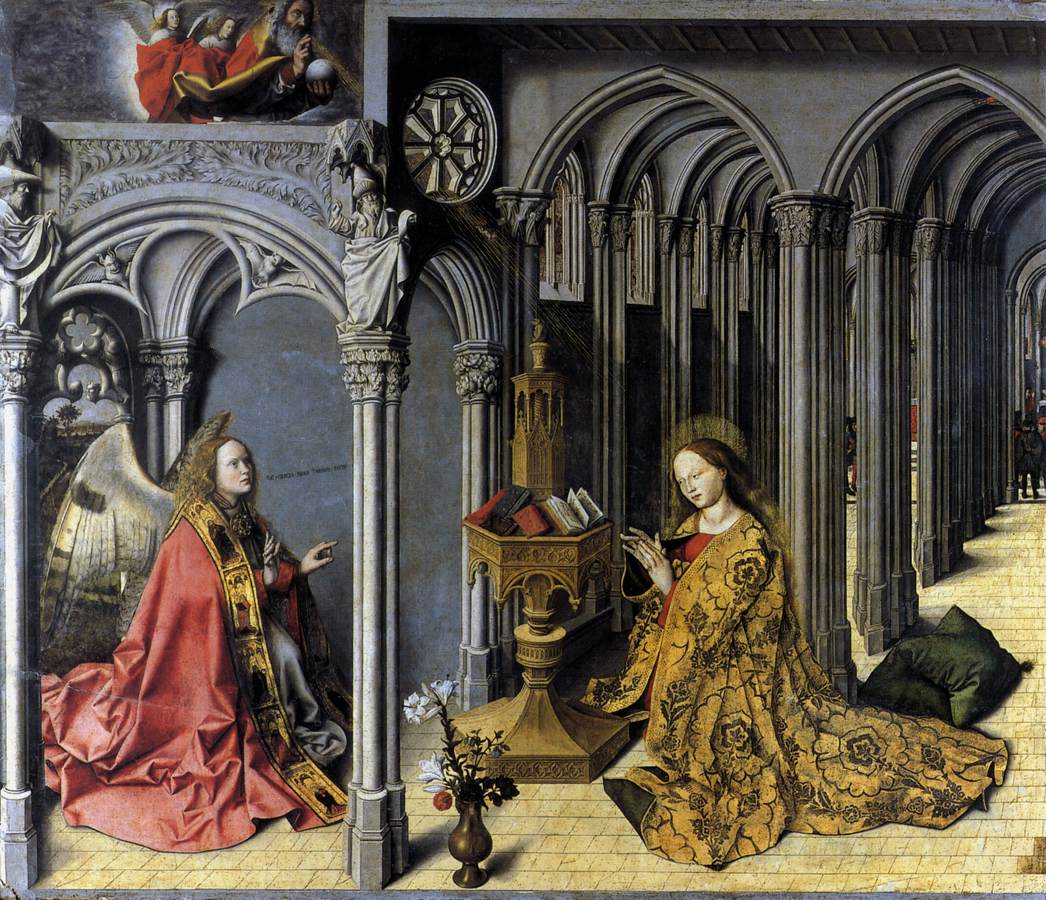
The art/graphic is a famous Annunciation altar piece in Aix-en-Provence.

Wednesday, August 26, 2009

Better 10 Graves Than One Extra Birth

You will want to pay attention to this and read it carefully.

Here is a provocative line:

The successes and failures of the expansion of Christianity are often mirrored precisely by the practice of this slaughter [of babies and children].
Now that I have your attention and before you read the rest of this fascinating post . . . .  I want to give full sourcing: This is from Father Z' s blog,  WDTPRS.  I have copied and pasted in full into my Catholic Notebook.   Add  WDTPRS to your favorites for excellent information and commentary. Father Z bolds to clarify his emphasis and adds his commentary in red. It is very helpful!

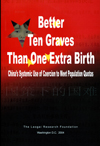
Sandro Magister of Chiesa has a fascinating piece on an article from an Italian daily on the new book by Harry Wu Better Ten Graves Than One Extra Birth: China’s Systematic Use of Coercion to Meet Population Quotas.

Here is Magister’s introduction to the excerpts:

ROME, August 14, 2009 – "Better ten graves than one extra birth," preaches a slogan of the one-child campaign in China. And this is also the title of the book in which Harry Wu has described and analyzed the Chinese anti-childbearing policy, made up of sterilization, forced abortion, infanticide.

The book was released in the United States, where Wu lives – in exile from China – and heads the Laogai Research Foundation. And now it has also been released in Italy, just as [get this…] the parliament approved, on July 15, a motion that requires the Italian government to present to the general assembly of the United Nations a resolution against abortion as a means of population control, and for the affirmation of the right of every woman  not to be forced to abort.

In China, the obligatory one-child policy was introduced in 1979. Wu’s assessment of these thirty years is expressed well in the title of his book in its Italian version: "Slaughter of innocents."

The book has been highlighted in Italy mainly by two newspapers: "Avvenire," owned by the episcopal conference, and "Il Foglio," directed by Giuliano Ferrara, a non-Catholic intellectual deeply involved in the defense of unborn life and in promoting an international moratorium on abortion.

The following article appeared in "Il Foglio" on July 29, 2009. The author takes his cue from Wu’s book. But he goes farther. He shows that the slaughter of the unborn and of infants is not the sole prerogative of China over the past few decades, but has accompanied many civilizations over the span of millennia. Pagan ancient Rome had it. The China of past centuries had it. Today’s India has it. The missionary expansion of Christianity has often found it it on its path.

Not only that. Abortion and infanticide are also regaining ground in the West today. They are common currency in the "new world" promoted by bioethicists like Peter Singer. They emerge in laws like the one providing for the euthanasia of children up to the age of twelve, in Holland.

[Get this…] The successes and failures of the expansion of Christianity are often mirrored precisely by the practice of this slaughter.
It would seem that Christianity is in a perpetual cage match with the culture of death.

If that isn’t enough to get your attention….  here is the rest of what Magister put on his site.

Be sure to visit Chiesa.  You get there things translated from Italian which you can’t find anywhere else.  

You can purchase Harry Wu’s book using this link HERE.

Moratorium against the new pagans

by Francesco Agnoli

Harry Wu’s book "Better Ten Graves than One Extra Birth"- in Italy entitled "Slaughter of Innocents. The one child policy in China" – demonstrates how today, in the twenty-first century, thousands and thousands of children in that country are killed in their mother’s wombs, at any stage of gestation, or are drowned, strangled, left to die in the cold once they are born. Similar things also happen in India.  [And… it would also be the case in … Illinois?]

So then, anyone who loves history knows that what is happening today in these two huge countries, which together constitute almost one third of the world population, has always happened in the past, including in old Europe or in the New World. Up until the coming of Christianity.  [The fact is that Christianity and the "culture of death" are locked through the millennia in a war to the end.]

One of the ideas that recur most in the writings of the first Christians is in fact their desire to frequently repeat one concept: we Christians are different from the pagans, in part because we do not kill our children, neither within our women’s wombs or outside of them[We do not kill our children.  We do not kill our children.  Tell that the Catholic politicians, any Christian politician, who supports abortion legislation.]

In chapter XXX, paragraph 2 of his "Octavius," the second-century apologist Minucius Felix, [Perhaps the earliest Latin writer… some say Tertullian, some say Minucius Felix.] comparing the teaching of Christ with that of the pagans, writes: "you expose your newborn children to wild beasts and to birds; or strangling them you crush with a miserable kind of death. There are some women who, by drinking medical preparations, smother in their very bowels the seed destined to become a human creature, and thus commit a parricide before they bring forth. And you learn these things from your gods, for Saturn did not simply expose his children, but even devoured them."

For his part, the great Tertullian, in his "Apologeticum," chapter IX, states: "For us Christians murder is expressly forbidden, and therefore it is not even permitted for us to destroy the fetus in its mother’s womb. Preventing birth is murder in advance. It doesn’t matter at all whether one destroys a life already born or crushes it at birth: what is about to be born is already a human being. Every fruit is already contained in its seed."

Another very important document from second-century Christianity, written in Asia Minor, the Letter to Diognetus, reiterates the same ideals in this rather concise manner: "Christians marry like everyone else and produce children, but they do not throw away their newborns."

On this same theme of infanticide, the historian A. Baudrillart has written: "There may be no matter on which ancient pagan society and modern Christian society are in more stark opposition than in their respective ways of thinking about children."

In effect, if we look at the ancient world, we note that abortion and infanticide are fairly widespread. "Seneca," recalls the American sociologist Rodney Stark in ‘The Rise of Christianity, "regarded the drowning of children at birth as both reasonable and commonplace. Tacitus charged that the Jewish teaching that it is ‘a deadly sin to kill an ‘unwanted child’ was but another of their ‘sinister and revolting’ practices. It was common to expose an unwanted infant out-of-doors where it could, in principle, be taken up by someone who wished to rear it, but where it typically fell victim to the elements or to animals and birds."

So in Rome just as in Greece, children were casually killed, or sold, or exposed and left to die of hunger and cold when there was no one to rescue them, usually in order to make them slaves. We know of the discovery, in the Roman sewers, of piles of bones from  infant children who were abandoned and then thrown away like trash or garbage.

The victims of infanticide were usually girls, as in China and India today, while abortion, in addition to killing the fetus, often killed the mother as well, or left her sterile.

The first Christians’ refusal to resort to abortion and infanticide, which was connected to a high rate of fertility among them, was not only a great victory of humanity, but also one of the elements that, together with conversions, allowed the first Christians to expand more and more, to the point of surpassing the pagans in numbers[Do you get that?  And what do we face in many Western nations today with an aging population?]

But infanticide was not practiced only in Rome, as demonstrated in part by the legend of Romulus and Remus, or in Greece, but in the entire ancient world.

The [monster but] famous bioethicist and animal rights supporter Peter Singer forcefully upholds the idea that this ancient practice should be rediscovered today, together with legal abortion.  In fact, if it is true that only Christians forcefully rejected it – Singer argues – why should we believe that they alone were right, while all the other peoples and religions of the past were wrong?

"Killing unwanted infants or allowing them to die has been a normal practice in most societies throughout human history and prehistory. [Because we did it before, we should do it now.  Is that the argument?  We used to enslave black Africans too.  Should we do that again?] We find it, for example, in ancient Greece, where disabled infants were exposed on the mountainside. We find it in nomadic tribes like the Kung of the Kalahari Desert, whose women will kill a baby born while an older child is still too young to walk. Infanticide was also common on Polynesian islands like Tikopia, where food supplies and population were kept in balance by smothering unwanted newborn infants. In Japan before westernisation, ‘mabiki’ – a word that has its origins in the thinning of rice seedlings so that there is room for each plant to flourish, but which came to be applied to infanticide too – was very widely practiced, not only by peasants with limited amounts of land, but also by those who were quite well off."

With the spread of Christianity over much of the world, abortion and infanticide became much more rare and isolated phenomena, while legislation, beginning with Constantine, intervened in defense of infants, and works of charity and assistance were developed for abandoned children and for families in difficulty.  Up until the return of abortion in communist and Nazi legislation in the twentieth century, and of infanticide with the new law on euthanasia for children up to the age of twelve, in Holland.

***

If we turn our minds now to the two huge countries in which abortion, even forced abortion, and infanticide are mass phenomena, it is easy, after this brief excursus, to understand the reason for all this: China and India are among the countries least penetrated by the Gospel of Christ, and Western culture with it, which intentionally or not is a bearer of this message, or at least of part of it.

When the first Jesuit missionaries reached China, they were rather impressed by this great civilization. But what made the biggest negative impression on the great Matteo Ricci, when he set foot in the Celestial Empire in 1583, was the widespread prostitution, the rampant corruption, the frenzy for money, and above all, the extent of the practice of infanticide. The communist regime, which is capable of planning millions of forced abortions, mass sterilizations, mass killing of infants, still has a long way to come, but respect for children, in that country which is admirable in other ways, is entirely missing.

As J. J. Matignon would write at the beginning of the twentieth century in "Superstition, crime e misère en Chine," the Chinese often sell their daughters as prostitutes, or kill them, because of poverty but also because of their magical superstitions, their obsessive ancestor worship: "As it always has in China, superstition plays a key role: in fact, the eyes, nose, tongue, mouth, brain of children are believed to be organic materials endowed with great therapeutic power. It can happen that after giving birth the mother falls ill, and then, in order to appease the spirits, the girls or in certain cases the boys are destroyed. There are women who have the specific task of bringing about the death of newborn girls . . . The newborns are destroyed by tossing them into a corner of the house or a garbage bin, where the dust and filth will not take long to block the child’s respiratory tract." Other times the children are drowned or smothered with pillows, although the influence of the Europeans, Matignon concludes, seems to have a certain limiting effect on these customs.

During Matignon’s own time, two missionaries were saying the same things about China. The first was a Jesuit, Saint Alberto Crescitelli, who was later decapitated and disemboweled at the age of 37, on July 21, 1900, during the Boxer Rebellion. The second was a Divine Word missionary from Val Badia, in Trentino Alto Adige, Saint Giovanni Freinademetz. Having arrived in the country that he would love his entire life, to the point of dying of typhus there, he wrote to his loved ones, on more than one occasion, that the Chinese have "the custom of exposing their own children, or simply exchanging or selling them . . . One of our best Christians, before his conversion, had killed his daughter by throwing her against the rocks, simply because she was crying too much" (Sepp Hollweck, "Il cinese dal Tirolo", Athesia, 2003).

In another letter, written from Hong Kong on April 28, 1879, Freinademetz recounts how the Catholic nuns had built two orphanages, where they received more than a thousand children per year. The Chinese "give them away for nothing or for a few pennies, and don’t give it another thought."

So the missionaries – he wrote from Puoli on July 2, 1882 – went through the streets looking for them, baptizing thousands of them at the point of death, and saving the ones they could: [How are our Catholic religious doing these days?] "Many souls have already been saved since we arrived here, many children of  pagans who died after being baptized, and again yesterday we had the solemn burial of a little girl of just over a year old, who had died. Her mother had wanted to strangle her in order to be able to breastfeed another woman’s child for money, she then heard that we accept  all sorts of children, and we raise them well; so she brought her to us more than two months later. The girl became ill, and died after being confirmed by us half an hour before her death. We wanted to bury her with great ceremony in order to demonstrate to the pagans how we honor their own children whom they throw away. The pagans here do not use coffins for little children, but as soon as they are dead they dig a hole and throw them in. We made the girl a beautiful little casket painted red, we dressed her in a beautiful blue dress and brought her to the church, all of us missionaries accompanied by the Christians, who had never seen anything like it. Many pagans came to see . . ." (G. Freinademetz, "Lettere di un santo," Imprexa).  [What will today’s pagans do?]

***

As in China, where today infanticide is nothing less than state business, a similar situation is found in India. In the huge country dominated by the Hindu religion as  well, killing, especially of girls, is very widespread, for economic and other reasons. The missionary agency "Asia News" recently reported this story: "Among tribal populations female children are regarded as a burden and social attitudes permit both foeticide and infanticide.  In 2006 eleven newborn girl babies were starved to death by their parents in a tribal hamlet of Ranga Reddy district, 80 km from Hyderabad.   It is a long-standing practice to wrap the unwanted girl child in a cloth and leave them to die. According to local press reports Jarpula Peerya Nayak, a 27 year old father said ‘My wife gave birth to a female baby for the third time, a daughter is a burden and we decided not to feed her. So she died. It is very difficult to bring up girls and marry them off’. On February 25, his cousin J. Ravi and wife Sujatha let their newborn baby starve to death. ‘My daughter died two days after birth since we did not feed her,’ admitted Ravi. ‘We already have two girl children and can’t afford to have one more.’ A tribal leader outlines the dowry he is expected to give for his daughter in marriage ‘a scooter, five to six tolas of gold and Rs 50,000 cash to a good groom.’ After starving and killing the girl children, the tribals dig a grave in their fields and bury them. Then they put a stone on the grave. Villagers said that dogs had eaten parts of the body of Ravi’s daughter and he had to bury her again.  Most of the 40-odd families in the village have either witnessed such killings or have performed it themselves over the years. Jarpula Lokya Nayak has starved to death two daughters."

In India as well, the efforts of the missionaries and of the Christian minorities is aimed, in addition to the attempt to break down the boundaries of caste and of social inequalities, to the defense of unborn life and of childhood, in the name of the God who became a child. Just one example is enough: that of Mother Teresa of Calcutta.

Everyone knows that the mission of this woman was that of helping the poor of India, the marginalized, the weak, the least. Among these, Mother Teresa never forgot to mention the children in their mother’s womb, whom she called "the poorest of the poor." In the book "Dateli a me. Madre Teresa e l’impegno per la vita", Pier Giorgio Liverani presents the thought of this holy woman, expressed in a thousand circumstances and with great power, as in these words of hers: "Abortion is the greatest destroyer of peace today. Because if a mother can kill her own child – what is left for me to kill you and you kill me – there is nothing between. This is what  I ask in India, and everywhere: What have we done for the child? We are fighting abortion by adoption, we have saved thousands of lives, we have sent words to all the clinics, to the hospitals, police stations – please don’t destroy the child, we will take the child."

The fight on behalf of children, against abortion and infanticide, has been conducted by Mother Teresa and her sisters, sometimes to the point of martyrdom, with great force, clashing with a culture unaware of the sacredness of life from its beginning. For the Hindus, for example, the children who are abandoned or rejected by their parents, if they survive, are and remain pariahs, outcastes making up for previous sins. Women in general, and girls even more so, are expensive because of their dowries, and are considered inferior to males, "to the point that they are not infrequently poisoned at the breast, which is sprinkled with poison while they are sucking their mother’s milk."

So it sometimes happens that there is a very high number of births, in the effort to have a boy at all costs, and as a result a high number of female infanticides: selective abortion is used until the child desired, a boy, is obtained. Mother Teresa and her sisters founded many houses of charity, schools, and orphanages, receiving great appreciation, but also the opposition of prime minister Morarji Desai, who in 1979 accused them of helping children with schools and orphanages for the sole purpose of baptizing and converting them. Mother Teresa responded to him: "It seems to me that you do not realize the evil that abortion is causing for your people. Immorality is on the rise, many families are breaking apart, there is an alarming increase in the cases of insanity among mothers who have killed their own innocent children. Mr. Desai: [Or … FILL IN THE BLANK]  it may be that before long you will find yourself face to face with God. I do not know what explanation you will be able to give him for having destroyed the lives of so many children who were unborn, but certainly innocent, when you find yourself before the judgment seat of God, who will judge you for the good you have done and for the evil you have caused from your high position in government."

And Mother Teresa added how over the previous year the 102 centers that she operated in Calcutta had seen 11,701 Hindu families, 5,568 Muslim families, and 4,341 Christian families who had been taught the meaning of the family, respect for life, the necessity of responsible procreation, reducing births without recourse to abortion or infanticide! The cry of the unborn children, of the slain infants, Mother Teresa said, echoing in another way the concepts expressed centuries and centuries before by Minucius Felix, Tertullian, and many others, "hurts the ear of God."
______
The book:

Harry Wu, "Better Ten Graves Than One Extra Birth: China’s Systematic Use of Coercion to Meet Population Quotas", Laogai Research Foundation, 2004.
The foundation established and directed by the author:
> Laogai Research Foundation

The newspaper in which Francesco Agnoli’s article appeared on July 29, 2009:
> Il Foglio

Harry Wu’s interview in  "Avvenire" on July 28, 2009:
> Il dissidente cinese Wu: Pechino, Erode invisibile

The articles from www.chiesa on two countries in which infanticide is a current practice:
> Focus on CHINA
> Focus on INDIA

English translation by Matthew Sherry, Ballwin, Missouri, U.S.A.

• • • • • •
Quote from  Chinh's News  all the news from China that's fit to read:
Harry Wu:
"Do you know [that] China today has an Internet police department," said Harry Wu. "They have about 200,000 to 300,000 policemen [whose] only job [is] Internet. Every individual or Internet café [is] controlled."
Blog Widget by LinkWithin