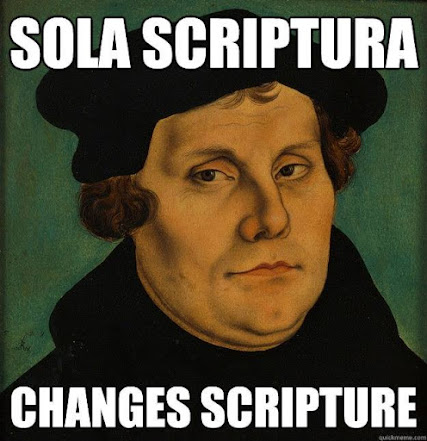
Question: What is Protestantism?
Answer: A new religion, invented and propagated by a man, named Martin Luther.
Q. Where was he born?
A. In Eisleben, of Prussian Saxony.
Q. Of what Religion were his parents?
A. They were Catholics, as were all his ancestors.
Q. At the time Luther was born, what was the religion of all Europe?
A. All believed what the Catholics believe at the present time.
Q. Was Luther himself a Catholic for any time.
A. He was a Catholic until his thirty-fifth year.
Q. What was his state of life?
A. He was a monk of the order of discalced Augustinians.
Q. As such had he made religious vows?
A. At the age of twenty-three years, he made vows of poverty, chastity, and obedience.
Q. Was he bound to keep these vows?
A. Without doubt, since he made them after mature reflection, and of his own free will; because the Prophet says, (Ps. xlix:) "Pay thy vows to the Most High;" and God himself says, (Num. ch. xxx:) "If any man make a vow to the Lord, or bind himself by an oath, he shall not make his word void, but shall fulfil all that he promised."
Q. Did Luther obey this command of God by keeping his vows?
A. No; he violated all the three; he apostatized,—he married Catherine de Boré, a nun, like himself under vows, and he utterly disobeyed every ecclesiastical authority.
Q. Was this man in reality the founder of the Protestant religion, and the first of that sect that ever appeared in the world?
A. Most certainly; for no minister, no congregation, no body of Divines professing Protestant doctrines, was ever heard of until his time.
Q. What inference do you draw from all this?
A. That Protestantism cannot be the religion of Christ; because, if the Church of Christ required reformation, a God of purity and holiness would never have chosen such an immoral character—an apostate, a wholesale vow-breaker, a sacrilegious seducer—for that purpose.
Q. What induced Luther to attack the ancient Catholic faith and invent a new creed?
A. Pride and jealousy. Pride Leo having granted an Indulgence, Luther's pride was mortified, because the commission to preach that Indulgence was given to the order of St. Dominic, and not to his own.
Q. To what did he allow himself to be driven by this pride and jealousy?
A. To attack the doctrine of Indulgences itself.
Q. Would the Catholic Church have blamed Luther had he merely attacked the abuses or avarice of individual Catholics?
A. No, certainly. He erred in this, that under pretence of reprehending abuses, he assailed the true faith on the subject of Indulgences.
Q. What was his next step?
A. He posted on the gates of the Church of Wittemburg, ninety-five articles, which he wrote and which contained many things not in accordance with the doctrines of the Church.
Q. Were these articles refuted?
A. They were, and with much ability, by some Catholic Theologians, to whom Luther replied with a haughty insolence unworthy of a Christian.
Q. What hypocritical pretences did Luther make in 1517, during these disputes?
A. He pretended that he wished to teach nothing but what was conformable to Scripture, to the Holy Fathers, and approved by the Holy See. (T.1. Ger. Edit. Gen. p. 12.)
Q. What did he write to Jerome, Bishop of Brandenburg?
A. That he wished to decide nothing himself, and that he wished to submit all his doctrines to the Church. (Ibid, p. 54.)
Q. What did he write to Pope Leo in 1518?
A. That he would listen to that Pope's decision as to an oracle proceeding from the mouth of Jesus Christ. (Ibid, p. 58)
Q. What did he promise to his religious superiors?
A. That he would be silent, if his adversaries were placed under the same restraint.
Q. What inference do you draw from all this?
A. That he was either a hypocrite who did not intend to fulfil his promises, or that he was quite satisfied of the truth of the doctrines which he impugned, since otherwise he could not conscientiously promise silence and obedience.
Q. What other consequences do you draw?
A. That a man swollen with pride, envy, jealousy—a disobedient hypocrite—was not the person to be chosen by God to reform abuses if any such existed.
Q. Can any one reasonably believe that the change in religion brought about by Luther is the work of God?
A. No one can believe it, unless he be utterly ignorant of the true nature of religion, and very unlearned in the matters of history.
Q. Why do you make this answer?
A. Because, in the first place, the author of the Reformation is not a man of God; secondly, because his work is not the work of God; thirdly, because the means which he used in effecting his purpose are not of God.
Q. Why do you say Luther is not a man of God?
A. Because he has left us in his works abundant proof, that if God saw a need for any reformation in his Church, such a man as Luther would not be selected to carry God's will into effect.
Q. What have you to blame in Luther's works?
A. They are full of indecencies very offensive to modesty, crammed with a low buffoonery well calculated to bring religion into contempt, and interlarded with very many gross insults offered in a spirit very far from Christian charity and humility, to individuals of dignity and worth.
Q. Passing over his indecencies in silence, give us a specimen of his buffooneries and insults. What does he say to the King of England, replying to a book which the King had written against him? (Tom. ii, p. 145.)
A. He calls the king "an ass," "an idiot," "a fool," "whom very infants ought to mock."
Q. How does he treat Cardinal Albert, Archbishop and Elector of Mayence, in the work which he wrote against the Bishop of Magdeburg? (Tom. vii, p. 353.)
A. He calls him "an unfortunate little priest, crammed with an infinite number of devils."
Q. What does he say of Henry, Duke of Brunswick? (Tom. vii, p. 118.)
A. That he had "swallowed so may devils in eating and drinking, that he could not even spit any thing but a devil." He calls Duke George of Saxony, "a man of straw, who, with his immense belly, seemed to bid defiance to heaven, and to have swallowed up Jesus Christ himself." (Tom. ii, p. 90.)
Q. Was Luther's language more respectful, when he addressed the Emperor and the Pope?
A. No; he treated them both with equal indignities; he said that the Grand Turk had ten times the virtue and good sense of the Emperor,—that the Pope was "a wild beast," "a ravenous wolf, against whom all Europe should rise in arms."
Q. What do you conclude from Luther's insolent, outrageous, and libertine manner of speaking?
A. That he was not the man to be chosen by God to reform his church; for his language is the strongest proof that he was actuated, not by the spirit of God, but by the spirit of the devil.
Q. May not his party say, that they care little about the manner of the man, if his doctrine be true,—that it is not upon him, but upon the word of God, they build their faith?
A. If the Protestant doctrine be true, then God used Luther as a chosen instrument to reestablish his true faith; but no reasonable man can possibly believe the latter; therefore, neither can any reasonable man believe that the Protestant is the true faith.
Q. May it not be objected that there were individual pastors in the Catholic Church as worthless as Luther?
A. Yes; but all the pastors of the Catholic Church were not so at one and the same time, whilst Luther, at the time we speak of, was the first and only teacher of Protestantism. Besides, Christ himself give an unanswerable reply to the objection, (Matth. xxiii:) "The Scribes and Pharisees have sitten in the chair of Moses; all things therefore whatsoever they shall say to you, observe and do, but according
to their works do ye not." Again, some Catholic pastors may have been bad men, but still they were the lawful ministers of God, having succeeded to lawfully commissioned predecessors; but Luther stood alone, he succeeded to none having lawful authority from whom he could derive a mission. In fine, whatever may have been the lives of some vicious Catholic pastors, they taught nothing new, their teaching was the same as that of the best and holiest ministers of the Church. Hence, there was no innovation in matters of faith, or principles of morality. But Luther was the first to teach a new doctrine, unknown in the world before his time.
Q. We are now satisfied that the author of Protestantism was not a man of God; show us that his undertaking was not from God;—what did he undertake?
A. He undertook to show that the Church had fallen into error, separated himself from her, and formed his followers into a party against her.
Q. Could such an undertaking be from God?
A. No; for God has commanded us not to sit in judgment upon the Church, but to hear and obey her with respect; "and if he will not hear the church, let him be to thee as the heathen and publican." (Matth. chap. xviii.)
Q. Was it the particular "territorial" Church of the Roman States, or the Universal Catholic Church, that Luther charged with having erred?
A. It was the Universal Church he dared to calumniate in this manner.
Q. How do you prove this?
A. Before the time of Luther, there was no Christian society in the whole world which believed the doctrines afterwards taught by Luther; consequently, he assailed not any particular sect or church, but the faith of the whole Christian world.
Q. Are you quite sure, that it is incontestably true, that no Christian body every believed, before Luther's time, the new doctrines be began then to propagate?
A. So sure, that we have Luther's own authority for it. His words are, (Tom. ii, p. 9, b. "How often has not my conscience been alarmed? How often have I not said to myself:—Dost thou ALONE of all men pretend to be wise? Dost thou pretend that ALL CHRISTIANS have been in error, during such a long period of years?"
"How often has not my conscience been alarmed? How often have I not said to myself:—Dost thou ALONE of all men pretend to be wise? Dost thou pretend that ALL CHRISTIANS have been in error, during such a long period of years?"
Q. What was it that gave Luther most pain, during the time he meditated the introduction of his new religion?
A. A hidden respect for the authority of the Church, which he found it impossible to stifle.
Q. How does he express himself on this matter? (Tom. ii, p. 5.)
A. "After having subdued all other considerations, it was with the utmost difficulty I could eradicate from my heart the feeling that I should obey the Church." "I am not so presumptuous," said he, "as to believe, that it is in God's name I have commenced and carried on this affair; I should not wish to go to judgment, resting on the fact that God is my guide in these matters." (Tom. p. 364, b.)
Q. What think you of the schism caused by Luther? Can one prudently believe that it is the work of God?
A. No; because God himself has forbidden schism as a dreadful crime: St. Paul (1st Corinth. chap. i. ver. 10) says: "Now I beseech you, brethren by the name of our Lord Jesus Christ, that you all speak the same thing, and that there be no SCHISMS among you; but that you be perfect in the same mind and same judgment."
Q. What idea did Luther himself entertain about schism before he blinded himself by his infuriated antipathy to the Pope?
A. He declared, that it was not lawful for any Christian whatever to separate himself from the Church of Rome.
Q. Repeat the very words of Luther touching this important matter. (Tom. i, p. 116, b.)
A. "There is no question, no matter how important, which will justify a separation from the Church." Yet, notwithstanding, he himself burst the moorings which bound him to the Church, and, with his small band of ignorant and reckless followers, opposed her by every means in his power.
Q. What do you remark on historical examples of conduct similar to this ever since the birth of Christianity?
A. That in every age, when a small body detached itself from the Church, on account of doctrinal points, it has been universally the case, that the small body plunged by degrees deeper and deeper into error and heresy, and in the end, brought by its own increasing corruption into a state of decomposition, disappeared and perished. Of this we have hundreds of examples; nor can Lutherans or Calvinists reasonably hope, that their heresy and schism can have any other end. They are
walking in the footsteps of those who have strayed from the fold of truth,—from the unity of faith; and they can have no other prospect, than the end of so many heresies that have gone before them.
Q. Why have you said, that the means adopted by Luther, to establish his new religion, were not of God? What were those means?
A. That he might secure followers, he employed such means as were calculated to flatter the passions of men; he strewed the path to heaven—not like Christ with thorns, but like the devil—with flowers; he took off the cross which Christ had laid on the shoulders of men, he made wide the easy way, which Christ had left narrow and difficult.
Q. Repeat some of Luther's improvements upon the religion of Christ.
A. He permitted all who had made solemn vows of chastity, to violate their vows and marry; he permitted temporal sovereigns to plunder the property of the Church; he abolished confession, abstinence, fasting, and every work of penance and mortification.
Q. How did he attempt to tranquillize the consciences he had disturbed by these scandalously libertine doctrines?
A. He invented a thing, which he called justifying faith, to be a sufficient substitute for all the above painful religious works, and invention which took off every responsibility from our shoulders, and laid all on the shoulders of Jesus Christ; in a word, he told men to believe in the merits of Christ as certainly applied to them, and live as they pleased, to indulge every criminal passion, without even the restraints of modesty.
Q. How did he strive to gain over to his party a sufficient number of presumptuous, unprincipled, and dissolute men of talent, to preach and propagate his novelties?
A. He pandered to their passions and flattered their pride, by granting them the sovereign honor of being their own judges in every religious question; he presented them with the Bible, declaring that each one of them, ignorant and learned, was perfectly qualified to decide upon every point of controversy.
Q. What did he condescend to do for Philip, Landgrave of Hesse, in order to secure his support and protection?
A. He permitted him to keep two wives at one and the same time. The name of the second was Margaret de Saal, who had been maid of honor to his lawful wife, Christina de Saxe. Nor was Luther the only Protestant Doctor who granted this monstrous dispensation from the law of God; eight of the most celebrated Protestant leaders signed, with their own hand, the filthy and adulterous document.
Q. Does the whole history of Christianity furnish us with even one such scandalous dispensation derived from ecclesiastical authority?
A. No; nor could such brutal profligacy be countenanced even for a moment, seeing that the Scripture is so explicit on the subject. Gen. ii, Matth. xix, Mark x, speak of two in one flesh, but never of three. But Luther and his brethren were guided, not by the letter of the Scripture, but by the corrupt passions, wishes, and inclinations of men. To induce their followers to swallow the new creed, they gave them, in return, liberty to gratify every appetite.
Q. If neither the author of Protestantism, nor his work itself, nor the means he adopted to effect his purpose, are from God, what are his followers obliged to?
A. They are obliged, under pain of eternal damnation, to seek earnestly and re-enter the true Church, which seduced by Luther, they
abandoned: If they be sincere, God will aid them in their inquiry.
Q. What is the situation of the man who does not at once acquit himself of this obligation?
A. He is the victim of mortal heresy and schism; the thing he calls a church has no pastors lawfully sent or ordained; hence, he can receive none of the Sacraments declared in Scripture to be so necessary to salvation.
Q. What think you of those (they are many) who are at heart convinced that the Catholic Church is the only true one, and are still such cowards as to dread making a public profession of their faith?
A. "He," says our Saviour—Luke, ix chap., 26 ver., "who shall be ashamed of me and of my words, of him the Son of Man shall be ashamed, when he shall come in his majesty."
Q. What think you of those who are inclined to Catholicism, but out of family considerations neglect to embrace it?
A. Our Saviour, in the 10th chap. of St. Matth., tells such, that he who loves father or mother more than God, is unworthy of God.
Q. What say you to those who become Protestants, or remain Protestants from motives of worldly gain or honor?
A. I say with our Saviour, in the 8th chap. of St. Mark, "What will it avail a man, if he gain the whole world, and suffer the loss of his soul?"
--R E V. S T E P H E N K E E N A N.


