That being shared . . . . What an awesome "sermon" to read preached by a Protestant.
Please note that bolding and paragraph breaks are my emphasis.
Soutenus
29 October 1995
by Stanley Hauerwas
I must begin by telling you that I do not like to preach on Reformation Sunday. Actually I have to put it more strongly than that. I do not like Reformation Sunday, period. I do not understand why it is part of the church year.
Wittenberg Door
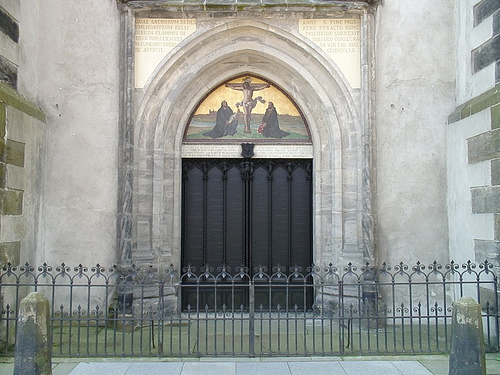
Reformation Sunday does not name a happy event for the Church Catholic; on the contrary, it names failure. Of course, the church rightly names failure, or at least horror, as part of our church year. We do, after all, go through crucifixion as part of Holy Week. Certainly if the Reformation is to be narrated rightly, it is to be narrated as part of those dark days.
Reformation names the disunity in which we currently stand. We who remain in the Protestant tradition want to say that Reformation was a success. But when we make Reformation a success, it only ends up killing us. After all, the very name ‘Protestantism’ is meant to denote a reform movement of protest within the Church Catholic. When Protestantism becomes an end in itself, which it certainly has through the mainstream denominations in America, it becomes anathema.
If we no longer have broken hearts at the church’s division, then we cannot help but unfaithfully celebrate Reformation Sunday.For example, note what the Reformation has done for our reading texts like that which we hear from Luke this morning. We Protestants automatically assume that the Pharisees are the Catholics. They are the self-righteous people who have made Christianity a form of legalistic religion, thereby destroying the free grace of the Gospel. We Protestants are the tax collectors, knowing that we are sinners and that our lives depend upon God’s free grace. And therefore we are better than the Catholics because we know they are sinners. What an odd irony that the Reformation made such readings possible. As Protestants we now take pride in the acknowledgment of our sinfulness in order to distinguish ourselves from Catholics who allegedly believe in works-righteousness.
Unfortunately, the Catholics are right. Christian salvation consists in works. To be saved is to be made holy. To be saved requires our being made part of a people separated from the world so that we can be united in spite of — or perhaps better, because of — the world’s fragmentation and divisions.
Unity, after all, is what God has given us through Christ’s death and resurrection. For in that death and resurrection we have been made part of God’s salvation for the world so that the world may know it has been freed from the powers that would compel us to kill one another in the name of false loyalties. All that is about the works necessary to save us.
For example, I often point out that at least Catholics have the magisterial office of the Bishop of Rome to remind them that disunity is a sin. You should not overlook the significance that in several important documents of late, John Paul II has confessed the Catholic sin for the Reformation. Where are the Protestants capable of doing likewise? We Protestants feel no sin for the disunity of the Reformation. We would not know how to confess our sin for the continuing disunity of the Reformation. We would not know how to do that because we have no experience of unity.
The magisterial office — we Protestants often forget — is not a matter of constraining or limiting diversity in the name of unity. The office of the Bishop of Rome is to ensure that when Christians move from Durham, North Carolina to Syracuse, New York, they have some confidence when they go to church that they will be worshiping the same God. Because Catholics have an office of unity, they do not need to restrain the gifts of the Spirit. As I oftentimes point out, it is extraordinary that Catholicism is able to keep the Irish and the Italians in the same church. What an achievement! Perhaps equally amazing is their ability to keep within the same church Jesuits, Dominicans, and Franciscans.
I think Catholics are able to do that because they know that their unity does not depend upon everyone agreeing. Indeed, they can celebrate their disagreements because they understand that our unity is founded upon the cross and resurrection of Jesus of Nazareth that makes the Eucharist possible. They do not presume, therefore, that unity requires that we all read Scripture the same way.
This creates a quite different attitude among Catholics about their relation to Christian tradition and the wider world. Protestants look over to Christian tradition and say, ‘How much of this do we have to believe in order to remain identifiably Christian?’ That’s the reason why Protestants are always tempted to rationalism: we think that Christianity is to be identified with sets of beliefs more than with the unity of the Spirit occasioned through sacrament.
Moreover, once Christianity becomes reduced to a matter of belief, as it clearly has for Protestants, we cannot resist questions of whether those beliefs are as true or useful as other beliefs we also entertain. Once such questions are raised, it does not matter what the answer turns out in a given case.
As James Edwards observes, “Once religious beliefs start to compete with other beliefs, then religious believers are — and will know themselves to be — mongerers of values. They too are denizens of the mall, selling and shopping and buying along with the rest of us.”
In contrast, Catholics do not begin with the question of “How much do we need to believe?” but with the attitude “Look at all the wonderful stuff we get to believe!” Isn’t it wonderful to know that Mary was immaculately conceived in order to be the faithful servant of God’s new creation in Jesus Christ! She therefore becomes the firstborn of God’s new creation, our mother, the first member of God’s new community we call church. Isn’t it wonderful that God continued to act in the world through the appearances of Mary at Guadalupe! Mary must know something because she seems to always appear to peasants and, in particular, to peasant women who have the ability to see her. Most of us would not have the ability to see Mary because we’d be far too embarrassed by our vision.
Therefore Catholics understand the church’s unity as grounded in reality more determinative than our good feelings for one another. The office of Rome matters. For at least that office is a judgment on the church for our disunity. Surely it is the clear indication of the sin of the Reformation that we Protestants have not been able to resist nationalistic identifications. So we become German Lutherans, American Lutherans, Norwegian Lutherans. You are Dutch Calvinist, American Presbyterians, Church of Scotland. I am an American Methodist, which has precious little to do with my sisters and brothers in English Methodism. And so we Protestant Christians go to war killing one another in the name of being American, German, Japanese, and so on.
At least it becomes the sin of Rome when Italian Catholics think they can kill Irish Catholics in the name of being Italian. Such divisions distort the unity of the Gospel found in the Eucharist and, thus, become judgments against the church of Rome. Of course, the Papacy has often been unfaithful and corrupt, but at least Catholics preserved an office God can use to remind us that we have been and may yet prove unfaithful. In contrast, Protestants don’t even know we’re being judged for our disunity.
I realize that this perspective on Reformation Sunday is not the usual perspective. The usual perspective is to tell us what a wonderful thing happened at the Reformation. The Reformation struck a blow for freedom. No longer would we be held in medieval captivity to law and arbitrary authority. The Reformation was the beginning of enlightenment, of progressive civilizations, of democracy, that have come to fruition in this wonderful country called America. What a destructive story.
You can tell the destructive character of that narrative by what it has done to the Jews. The way we Protestants read history, and in particular our Bible, has been nothing but disastrous for the Jews. For we turned the Jews into Catholics by suggesting that the Jews had sunk into legalistic and sacramental religion after the prophets and had therefore become moribund and dead. In order to make Jesus explicable (in order to make Jesus look like Luther — at least the Luther of our democratic projections), we had to make Judaism look like our characterization of Catholicism. Yet Jesus did not free us from Israel; rather, he engrafted us into the promise of Israel so that we might be a people called to the same holiness of the law.
I realize that the suggestion that salvation is to be part of a holy people constituted by the law seems to deny the Reformation principle of justification by faith through grace. I do not believe that to be the case, particularly as Calvin understood that Reformation theme. After all, Calvin (and Luther) assumed that justification by faith through grace is a claim about God’s presence in Jesus of Nazareth. So justification by faith through grace is not some general truth about our need for acceptance; but rather justification by faith through grace is a claim about the salvation wrought by God through Jesus to make us a holy people capable of remembering that God’s salvation comes through the Jews. When the church loses that memory, we lose the source of our unity. For unity is finally a matter of memory, of how we tell the story of the Reformation. How can we tell this story of the church truthfully as Protestants and Catholics so that we might look forward to being in union with one another and thus share a common story of our mutual failure?
We know, after all, that the prophecy of Joel has been fulfilled. The portents of heaven, the blood and fire, the darkness of the sun, the bloody moon have come to pass in the cross of our Savior Jesus Christ. Now all who call on that name will be saved. We believe that we who stand in the Reformation churches are survivors. But to survive we need to recover the unity that God has given us as survivors. So on this Reformation Sunday long for, pray for, our ability to remember the Reformation – not as a celebratory moment, not as a blow for freedom, but as the sin of the church.
Source: http://www.calledtocommunion.com/2009/10/stanley-hauerwas-on-reformation-sunday/Pray for God to heal our disunity, not the disunity simply between Protestant and Catholic, but the disunity in our midst between classes, between races, between nations. Pray that on Reformation Sunday we may as tax collectors confess our sin and ask God to make us a new people joined together in one might prayer that the world may be saved from its divisions.
(Stanley Hauerwas is the Gilbert T. Rowe Professor of Theological Ethics at Duke Divinity School.)
H/T Journey to Rome author, Kevin Branson says:
Stanley Hauer was is the Gilbert T. Rowe Professor of Theological Ethics at Duke University. He makes some good points in the sermon reprinted here (there, and everywhere). Hauerwas comes out of the gate admitting that he doesn’t like the fact that the Protestant celebration of the Reformation is a perpetual event, because it is a celebration of failure on a cosmic scale. I’m not endorsing Hauerwas as a theologian, but I do believe he honestly, and bravely, steps out from the crowd in this sermon and boldly goes where not many Protestants are willing, or able, to go.
These are not his words, but it occurs to me that celebrating the Reformation annually (and I used to do so in a big way) is like celebrating the day you divorced your wife each year when the date rolls around. And no matter how lousy you might believe your wife was, wouldn’t it be twisted to annually whoop it up and celebrate the tragic event! Very strange. What was I thinking as a Protestant when I annually celebrated schism in the Body of Christ? Sometimes we have the opportunity to look back at ourselves and just shake our heads at our thoughtlessness. Thank you Lord!
What is so gloriously wonderful about division in the body of Christ? Really! Oh yeah, now I remember: Doctrinal purity (according to your own interpretation or that of your pet theologian) trumps Christian unity. Sorry, I forgot.


 Jeff Tan says: