Most people know that Jesus died for their sins. But, as we shall see, according to the New Testament Jesus also rose for our salvation. This aspect of the biblical message is often neglected. The emphasis on usually on the cross. In fact, the resurrection for many people doesn't figure into their understanding of salvation very much. For most the resurrection is little more than "confirmation".
Yet a close look at Scripture reveals that the Resurrection is more than that! As Paul makes it clear, if Jesus didn't rise from the dead "your faith would be in vain" (1 Cor 15:14).
The work of salvation did not end at the cross. The Resurrection is part of Christ's work of salvation.
You can find the rest of this post at The Sacred Page, a blog written by three Catholic Ph.D.s who are professors of Scripture and Theology: Michael Barber, Brant Pitre and John Bergsma.

Or, over at Whispers in the Loggia there is a transcript of Pope Benedicts's Easter Vigil Homily. Here is part of it:
At the Easter Vigil, the journey along the paths of sacred Scripture begins with the account of creation. This is the liturgy’s way of telling us that the creation story is itself a prophecy.
It is not information about the external processes by which the cosmos and man himself came into being. The Fathers of the Church were well aware of this. They did not interpret the story as an account of the process of the origins of things, but rather as a pointer towards the essential, towards the true beginning and end of our being.
Now, one might ask: is it really important to speak also of creation during the Easter Vigil? Could we not begin with the events in which God calls man, forms a people for himself and creates his history with men upon the earth?
The answer has to be: no. To omit the creation would be to misunderstand the very history of God with men, to diminish it, to lose sight of its true order of greatness. The sweep of history established by God reaches back to the origins, back to creation.
How about this wonderful reflection from The New Theology Movement. Here is part of it:

Jesus rose in the very first rays of the dawn, moments before the women had arrived.
It is not the risen Christ which terrified the guards, but the angel. And the guards must have been terrified to realize that, though they had kept watch over the sealed tomb all night, yet the body of Christ was no longer inside! When had he risen? They had not seen it!
For a mystery so great, it is most fitting not that men should see the mystery directly, but that it should be revealed to them by the angels. Nor does this in any way compromise the testimony which the apostles and the other disciples have given of Christ’s Resurrection – for, although they did not see the Lord rise, they did see him risen. Moreover, of all the apostles, who has testified more compellingly of Christ’s Resurrection than St. Paul? Though he never knew Christ in his earthly life, nor did he witness the Lord rise from the dead, nor even did he see Jesus before his Ascension (for it was only by divine dispensation that the Apostle saw the Lord’s glorified body in the physical apparition on the way to Damascus); yet this Saint has been the greatest witness to the truth of Christ’s Resurrection.


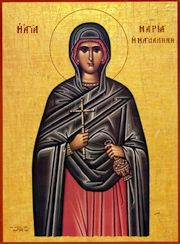
 Sister of St. Lazarus and St. Martha, she is called "the Penitent". St. Mary was given the name 'Magdalene' because, though a Jewish girl, she lived in a Gentile town called Magdale, in northern Galilee, and her culture and manners were those of a Gentile. St. Luke records that she was a notorious sinner, and had seven devils removed from her.