Showing posts with label Mother Teresa. Show all posts

Tuesday, July 14, 2015

Mother Teresa (Suffering)


The Innocent Suffering - 
"All that suffering-where would the world be without it? Innocent suffering is the same as the suffering of Jesus. He suffered for us and all the innocent suffering is joined to his in the redemption. It is co-redemption. That is helping to save the world from worse things."

Suffering is a gift - 
 Like all gifts, it depends on how we receive it. And that is why we need a pure heart to see the hand of God, to feel the hand of God, to recognize the gift of God in our suffering. He allows us to share in his suffering and to make up for the sins of the world."

Wasting suffering - 
"The important thing, is not to waste suffering. Join it to the suffering of Christ; offer it up with his suffering. Don't waste suffering ."

To Die daily to self...... -
"Lord, help us to see , in your crucifixion and resurrection, an example of how to endure and seemingly to die, in the agony and conflict of daily life, so that we might live more fully and more creatively.... Enable us to go through trials patiently and bravely, trusting that you will support us; for it is only by dying with you that we can raise with you. Amen."


And from Mother Teresa's mentor - St. Francis of Assisi...  
"This is perfect joy - to share in the sufferings of the world as Christ did."


Source: http://www.suffering.net/servmo-t.htm
Diverse articles on suffering: http://www.suffering.net/detail.htm#theresa

Monday, May 30, 2011

Receiving The Most Holy Eucharist

Here are some of the reasons I feel it important for me to receive Our Lord on my tongue and not in my hands.

~~> Council of Rouen (650 AD): "Do not put the Eucharist in the hands of any layperson, but only in their mouths"

~~> "If some nonbeliever arrived and observed such an act of adoration perhaps he, too, would 'fall down and worship God, declaring, God is really in your midst,'" explained Auxiliary Bishop Athanasius Schneider of Karaganda, Kazakhstan in the pages of L'Osservatore Romano.
[Exactly!  Kneeling is a symbol for the whole world to help non-believers see that we believe the Eucharist truly is our God]

~~> "Not very long ago I said Mass and preached for their Mother, Mother Teresa of Calcutta, and after breakfast we spent quite a long time talking in a little room. Suddenly, I found myself asking her -- don't know why -- 'Mother, what do you think is the worst problem in the world today?' She more than anyone could name any number of candidates: famine, plague, disease, the breakdown of the family, rebellion against God, the corruption of the media, world debt, nuclear threat, and so on.

"Without pausing a second she said, 'Wherever I go in the whole world, the thing that makes me the saddest is watching people receive Communion in the hand.'"

(Father George William Rutler, Good Friday, 1989 in St. Agnes Church, New York City, a precise transcript taken from a tape of his talk available from St. Agnes Church. Note: Fr. Emerson of the Fraternity of St. Peter was also a witness to this statement by Blessed Mother Teresa)

~~> Blessed Mother Teresa: Blessed Mother Teresa said, "Further it is the custom in our Society, and my known wish, that the Sisters receive Holy Communion on the tongue, which to my knowledge they are doing everywhere" (Mother Theresa, India 1995; Athi Thoothan Editor, Aquinas, p. 13, Vol 2, No 1 March 2000).

~~>  Fr. John Hardon, S.J.: Whatever you can do to stop Communion in the hand will be blessed by God.” (November 1st, 1997 Call to Holiness Conference, Detroit, Michigan, panel discussion.)

~~> Pope John II: He only gave Holy Communion on tongue during private Masses in the Vatican. Concelebrating priests were told to do the same. Pope John Paul II said, "I do not revoke what one of my predecessors has said about this... ... here, my dear priests and my dear brothers and sisters, only Communion on the tongue and kneeling is allowed. I say this to you as your bishop!" (Sermon, March 1, 1989, Church of SS. Nome Di Maria)

When the wife of the President of France, Madame Giscard d'Estaing came before the Holy Father with outstretched hands, Pope John Paul II placed the host in her mouth. (Homiletic & Pastoral Review, March 1997 pg 24). He did likewise for a canon lawyer who was present at the 1981 Papal Mass in Chicago.


~~> Pope Paul VI: Memoriale Domini, a 1969 document, recognized that communion on the tongue was conducive to faith, reverence and humility. Specifically, the document states, "With regard to the manner of administering the sacrament, one may follow the traditional method, which emphasized the ministerial function of the priest or deacon, in having them place the host in the hand of the communicant." In the same document it is also written, "To preserve and defend the reverence, dignity and holiness due to the greatest treasure in the Church, only kneeling, not standing, to receive Holy Communion, always on the tongue, was allowed." Thus, the document not only allows Communion on the Hand but also Communion in the Hand. However, due to irreverence and a disbelief in the Real Presence in recent times as well as the common error of receiving Our Lord simply "out of habit", I urge fellow Catholics to receive the Eucharist joyfully on the tongue. Below is my final excerpt from the document:
A change in a matter of such moment, based on a most ancient and venerable tradition, does not merely affect discipline. It carries certain dangers with it which may arise from the new manner of administering holy communion: the danger of a loss of reverence for the august sacrament of the altar, of profanation, of adulterating the true doctrine.

~~> First of all, to receive is something that is passive. The priest takes Holy Communion because the priest is the one who offers the Victim in sacrifice. Therefore, the one who offers the Victim must also take part in that Victim. But the people of God are to receive Holy Communion. To take the Host from your hand and put It into your own mouth is to take Communion, not to receive Communion; and so it is an active thing, not a passive thing. The Lord desires to give Himself to you as a gift, not to be taken by you. We need to be very careful that we do not lose the symbolism of what is happening in the Blessed Sacrament.  (Father Robert Altier) Father's complete statement is copied and pasted below the SOURCES.

~~> Holy Scripture: In the Old Testament, it is recorded that only Levite priests were allowed to carry the Ark of the Covenent (1 Chronicles 13:2), and when a non-Levite priest touched the Ark of the Covenent he was struck dead (1 Chronicles 13:9). Today the Holy Eucharist is the Holy of Holiess, and only those who have been consecrated to touch the Eucharist (Summa, Pt III Q, Q2 Art. 3) should touch it.


SOURCES:
A Catholic Life
Vatican Newspaper: Receive Communion on Tongue, Kneeling
LifeSiteNews 
** Mission: Restore Eucharistic Reverence ** 
Catholic Apologetics Notebook
The Beauty and Spirituality of the Traditional Latin Mass


Fr. Robert Altier:

"In the first reading today Saint Paul, in his Letter to the Colossians, talks about how, in Christ, is hidden all treasures of wisdom and knowledge. This is because He is almighty God; He is the Creator of the universe; He is the Savior of the world; He is God, absolute and perfect. Saint Paul says at the beginning of the reading that he makes up in his flesh for what is lacking in the
suffering of Christ, for the sake of Christ's body, the Church.

"In Christ, now, there is no suffering, but only in the Mystical Body. But there is one place, which I would like to address this morning, where I believe that Our Lord is truly grieved. I want to challenge you in that area: That is, the manner by which we receive Holy Communion.

"The Church is very clear in Her documents that she desires that we would receive Holy Communion on the tongue and not in the hand.

"The bishops of America, as well as a few other countries in the world, have allowed Communion in the hand as a dispensation. But the Church is very, very clear that She does not want us receiving Communion in the hand.

"Let me explain a little as to why. First of all, to receive is something that is passive. The priest takes Holy Communion because the priest is the one who offers the Victim in sacrifice. Therefore, the one who offers the Victim must also take part in that Victim. But the people of God are to receive Holy Communion. To take the Host from your hand and put It into your own mouth is to take Communion, not to receive Communion; and so it is an active thing, not a passive thing. The Lord desires to give Himself to you as a gift, not to be taken by you. We need to be very careful that we do not lose the symbolism of what is happening in the Blessed Sacrament.

"Also, if you will notice, during Mass after the Consecration, my fingers remain together because of the particles of the Host that are there. When we take Holy Communion in the hand, there are particles of Our Lord that are on our hands and on our fingers. That is why, after Communion, the priest will purify his fingers - because of the particles of the Host. But how often the people of God, after receiving Holy Communion, simply brush the particles onto the ground and walk on Our Lord. Or they put their hands in their pockets, and Our Lord is right there on their clothing. The abuses that this opens them up to are very grave. Not that anyone is intentionally doing that, but I think it is something that we need to consider exceedingly carefully.

"What I always tell people is that you can look forward to the Day of Judgment and ask yourself how you intend to approach Our Lord, because He is your Judge. The same Lord you approach in Holy Communion is the same One you will approach on the Day of Judgment. Do you assume that you will put your hand out to Our Blessed Lord on the Day of Judgment?

"Is your view of judgment that you will shake Our Lord's hand and tell Him how wonderful it is to see Him? Or is your view that you will do great reverence to Our Blessed Lord? My view is that I will be flat on my face - not shaking His hand.

"We do not put out our hand to God. Scripture says that God holds us in the palm of His hand. We should not be holding God in the palm of ours. He created us; He made us in His image and likeness. He is the Creator; we are the creature. We must approach Him with the greatest reverence, the greatest respect.

"If we simply look at the fruit that has been borne by Holy Communion being taken in the hand, it is not good: the loss of reverence for the Blessed Sacrament, the familiarity.

"Thankfully it is not happening here, but go to most churches and ask yourself if you see people praying before Mass or if they are chatting, goofing around, and talking.

"We have lost the reverence for the Real Presence because Jesus is just "our buddy" when we put our hand out to Him; He is not our God when we do that. So we need to be very careful.

"But beyond that, we can look also at what has happened spiritually to the people of God. Since we have been receiving Communion in the hand, we have lost sight of the idea of going to Confession, of our own sinfulness, of the reverence we must have for Our Lord. We have made Communion so easy a thing and so nonchalant a thing that people have lost that sense of reverence, of awe, and of respect in the Presence of Our Lord.

"I challenge you to think very seriously about this issue. The bishops, like I say, have allowed it; it is not a sin if you receive Holy Communion in the hand. In some places in the early Church they did that; Saint Justin talks about it. But the Church stopped it because of the abuses against the Blessed Sacrament that were occurring. I ask you to really pray about that.

"Look at Jesus in the Eucharist and ask yourself, "Do I really, truly believe that this is God? That this is my Creator and my Redeemer? How, then, do I desire to approach Him?" I really believe, if you pray that through, that there is only one conclusion to which you can come.

"Then, I beg you, do not remain silent about it. Tell your friends. Tell your family. Bring that word to others because all those good people out there, I do not think that they are willfully trying to do anything that would grieve Our Lord; they are doing what they have been told to do.

"But again, look at what has happened in the last forty years of this particular practice and ask yourself if the fruit it has borne has been good. Obviously, you love Our Lord: You are here at daily Mass; you are here every morning. The love of Our Lord is evident in you. Bring that love of Jesus out from here. The love that is in your heart, proclaim it to others and ask them in the same way to consider their actions toward Our Lord.

"Let us bring the reverence to Our Lord in the Blessed Sacrament back so that we can give Him fitting worship and praise because He is God, in whom all the treasures of wisdom and knowledge are contained."

Sunday, February 28, 2010

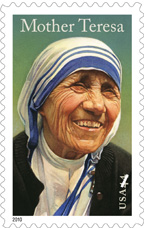
Mother Teresa Postage Stamp

Please take 15 seconds and sign the petition at StampOutBigotry.com to urge the Post Office to issue their new stamp honoring Mother Teresa. Atheist groups are mounting a campaign to censor the stamp and we need to fight back.

Sign the petition now at www.StampOutBigotry.com

I have copied and pasted the letter to the Postmaster General. If you agree, please click over and sign the petition.


Dear Postmaster General,

We are shocked and saddened by reports that atheist groups are now mobilizing to stop the USPS from issuing a new stamp honoring Mother Teresa.

I urge you to stand by your decision to issue the stamp on August 26th, and to reject the bigoted attacks aimed at trashing this faith-filled nun who spent her life caring for the poor and needy of our world.

The group protesting the stamp has unjustly accused Mother Teresa of having a “dark side,” and has attacked her for using her religious faith in her service to the sick and poor. Furthermore, these same groups never protested a stamp honoring Rev. Martin Luther King Jr., though he proudly understood his fight for civil rights to be rooted in his Christian faith.
Mother Teresa Stamp
With love and her charity, Mother Teresa cared for tens of thousands of people regardless of need, race, sex, or religion. She cared for people because they were human, and continues to inspire millions of people even after her death.

In 1979, Mother Teresa received the Nobel Peace Prize for her tireless service to the poor. The charity she founded continues to help people in India and throughout the world, including the United States.

For these reasons, we strongly encourage you to stand by your decision to issue this stamp.

Please stamp out this religious bigotry, and issue the Mother Teresa stamp as promised on August 26th.

Sincerely,

Brian Burch
President
CatholicVoteAction.org

Thursday, October 15, 2009

Friday, September 4, 2009

Poverty at Home

"I want you to find the poor here, right in your own home first. And begin love there. Be that good news to your own people. And find out about your next-door neighbor — do you know who they are?
I had the most extraordinary experience with a Hindu family who had eight children. A gentleman came to our house and said: Mother Teresa, there is a family with eight children, they had not eaten for so long — do something. So I took some rice and I went there immediately.
And I saw the children — their eyes shinning with hunger — I don't know if you have ever seen hunger. But I have seen it very often. And she took the rice, she divided the rice, and she went out.
When she came back I asked her — where did you go, what did you do? And she gave me a very simple answer: They are hungry also. What struck me most was that she knew — and who are they, a Muslim family — and she knew. I didn't bring more rice that evening because I wanted them to enjoy the joy of sharing. But there were those children, radiating joy, sharing the joy with their mother because she had the love to give. And you see this is where love begins — at home."
(That is an excerpt from Mother Teresa's Nobel Peace Prize Acceptance Speech 1979)

Sometimes we need to step back and get a perspective that is not laced with personal concerns, personal fears and personal agendas. For all of us in the U.S. --- let's step out of the forest around us for a moment and look these maps of poverty in our country. The numbers have not changed that much since this study was done.
Let's take look at our neighbors:
In the 837 shaded counties below, more than 20 percent of the people lived in poverty in 1990.


This next map shows the 418 counties with more than 25 percent of their residents living in poverty. An Appalachian cluster remains distinct. The Mississippi Delta, the Four Corners area, and the Texas border come more sharply into focus as other regions of extreme poverty.

This final map shows the 193 counties with more than 30 percent of their people in poverty.

This is also this telling graph from the census report.


Now ZOOM IN to your home and look right.....and left.....
I am doing the same thing right now. I see neighbors I can do more to help.
Zoom out just a tad .....
I am doing this with you. I see people in community that I can help.
I have been on both sides -- needing and giving.
Sometimes it helps to simply have someone to talk to, to pray with, to offer a warm shower or a couch to sleep on. Sometimes it helps to just have a hug or hand me down clothes.
I have learned that, certainly, when you are without a place to lay your head or without food to feed your baby you NEED immediate help. I have also learned that when we are somewhat comfortable financially (i.e. not homeless) sometimes we NEED to give more than we know.

Tuesday, September 1, 2009

Blessed Teresa of Calcutta Feast Day - September 5

This Saturday the Church will celebrate the feast day of Mother Teresa.

Read the deatils here: CatholicNewsAgency


"Give yourdelf fully to God. He will use you to accomplish great things on the condition that you believe much more in His love than in your own weakness."

Tuesday, January 27, 2009

My Beacon Word

Bia's post about resolutions in a single word got me thinking. I am not a yearly resolution maker. Why?
Well. . . .
  • it is too disappointing when I break the resolution
  • it is too static when, 3 months later, I realize it no longer applies or has been overshadowed by another, more timely resolve.
  • it is too much like what I do everyday. I, too, am a list maker. Those lists carry resolutions within them ~~~~~~~~~~~~~~~~~~~~>
  • it is too contrived for me. . . WHY the emphasis on New Year's Day?
On the other hand, I do like to set goals because those you can refine, progress toward and keep alive in every step forward.

Bia closed her post with this quote that I love.

Blessed Mother Teresa of Calcutta once said,
“Yesterday is gone. Tomorrow has not yet come. We have only today. Let us begin.”

With that in my mind I find I CAN choose a word for the year - yet I hasten to say it is not a resolution but more of a beacon word. With God's grace and guidance I would like to embody it and embrace it. Here it is -


RESILIENCE (re·sil·ience) an ability to recover from or adjust easily to misfortune or change


Friday, May 30, 2008

Roe v. Wade has Deformed a Great Nation

Quoted in The Wall Street Journal in 1994, Mother Teresa said,
"America needs no words from me to see how your decision in Roe v Wade has deformed a great nation. The so-called right to abortion has pitted mothers against their children and women against men. It has sown violence and discord at the heart of the most intimate human relationships. It has aggravated the derogation of the father's role in an increasingly fatherless society. It has portrayed the greatest of gifts — a child — as a competitor, an intrusion and an inconvenience. It has nominally accorded mothers unfettered dominion over the independent lives of their physically dependent sons and daughters. "


sources: http://www.lifesitenews.com/ldn/2008/jan/08010905.html
http://www.ewtn.com/New_library/prolife.htm

Some babies die by chance. No baby should die by choice


Saturday, February 23, 2008

Prayer Quotes

H/T to Mom2Twelve and A Catholic Mom Climbing the Pillars

St. Teresa of Avila,
"Give me a person who has fifteen minutes of mental prayer daily, and I will give you a saint."
St. Therese of Lisieux centuries later said,
"For me, prayer is an upward leap of the heart, an untroubled glance toward heaven, a cry of gratitude and love which I utter from the depths of sorrow as well as from the heights of joy."
Prayer and silence go well together.
The fruit of SILENCE is prayer
The fruit of PRAYER is Faith
The fruit of FAITH is Love
The fruit of LOVE is Service
The fruit of SERVICE is Peace.
~Mother Teresa

H/T to A Concord Pastor Comments:


Poet Scott Cairns recounts a Dan Rather interview with Mother Teresa in which he asked her what she says to God when she prays.
"I don't say anything," she said. "I just listen."
Then the interviewer asked her what God says to her.
"He doesn't say anything," she responded. "He just listens."

Thursday, September 27, 2007

First Things on Mother Teresa

Back in 2003, Carol Zaleski wrote about Bl. Mother Teresa's "dark night" for First Things.
Here excerpts: Fr. Kolodiejchuk sees Mother Teresa’s life as unfolding in four phases:

1. Her childhood and youth, when from the time of her First Communion at age five and a half she felt her heart captivated by the love of Jesus and of neighbor, and discovered her call to join the missionary Sisters of Our Lady of Loreto. While it was difficult to leave her family, she found her time as a Loreto nun, teaching in the convent school in Calcutta, immensely rewarding. She was by all accounts a happy though not particularly brilliant nun (she is remembered, among other things, for having fumbled the candles at Benediction). The keynote of this period is youthful zeal and joy.
2. The Vow of 1942. At age thirty-two, at the end of her annual retreat, with the permission of her spiritual director, Mother Teresa made a vow to give herself utterly and unreservedly to Christ: “To give God anything that He may ask . . . not to refuse Him anything.”
3.
The Call within a Call. On September 10, 1946, the day c
elebrated by the Missionaries of Charity as “Inspiration Day,” Mother Teresa was traveling by train from Calcutta to a retreat house in Darjeeling. During this trip, the realization came to her that Jesus was calling her to serve him radically in the poorest of the poor. Only in private letters to her spiritual director, Fr. Celeste Van Exem, S.J., and (under Fr. Van Exem’s cautious instruction) to Archbishop Ferdinand Périer, S.J., did she reveal that this call was more than just an inner prompting. Jesus appeared and spoke to her, in a series of interior locutions and visions. “Wouldst thou not help?” Jesus asked her. “How can I?” Mother Teresa responded, expressing her fear of incurring ridicule, loneliness, deprivation, and failure should she leave her happy life as a Loreto nun, exchange her habit for a rough sari, and take up the uncertain life Jesus was demanding of her. Repeatedly he asked her, “Wilt thou refuse? You have become my spouse for my love. You have come to India for me. The thirst you had for souls brought you so far. Are you afraid now to take one more step for your spouse, for me, for souls?” And again: “I want Indian nuns, Missionaries of Charity, who would be my fire of love amongst the poor, the sick, the dying, and the little children. . . .” The chief motivation for the Missionaries of Charity, as she would often say, was not to do social work, but to adore Christ in the littlest and weakest of his children, and to bring Christ the souls for which he thirsts.
4.
The Dark Night. Throughout 1946 and 1947, Mother Teresa experienced a profound union with Christ. But soon after she left the convent and began her work among the destitute and dying on the street, the visions and locutions ceased, and she experienced a spiritual darkness that would remain with her until her death. It is hard to know
what is more to be marveled at: that this twentieth-century commander of a worldwide apostolate and army of charity should have been a visionary contemplative at heart; or that she should have persisted in radiating invincible faith and love while suffering inwardly from the loss of spiritual consolation. In letters written during the 1950s and 1960s to Fr. Van Exem, Archbishop Périer, and to later spiritual directors, Fr. L. T. Picachy, S.J., and Fr. J. Neuner, S.J., she disclosed feelings of doubt, loneliness, and abandonment. God seemed absent, heaven empty, and bitterest of all, her own suffering seemed to count for nothing, “. . . just that terrible pain of loss, of God not wanting me, of God not being God, of God not really existing.” The dark night of Mother Teresa presents us with an even greater interpretive challenge than her visions and locutions. It means that the missionary foundress who called herself “God’s pencil” was not the God-intoxicated saint many of us had assumed her to be. We may prefer to think that she spent her days in a state of ecstatic mystical union with God, because that would get us ordinary worldlings off the hook. How else could this unremarkable woman, no different from the rest of us, bear to throw her lot in with the poorest of the poor, sharing their meager diet and rough clothing, wiping leprous sores and enduring the agonies of the dying, for so many years without respite, unless she were somehow lifted above it all, shielded by spiritual endorphins? Yet we have her own testimony that what made her self-negating work possible was not a subjective experience of ecstasy but an objective relationship to God shorn of the sensible awareness of God’s presence. In the history of Christian theology and spirituality, there have been many accounts of divine darkness, with a host of different implications. It is an ancient doctrine, emphasized by apophatic theologians and mystics, that God dwells in inaccessible light, a light so searingly absolute that it cancels out all images and ideas we may form of Him, veiling the divine glory in a dark “cloud of unknowing.” This tradition owes much to the Christian Neoplatonist Dionysius the Pseudo-Areopagite and his liturgically inspired vision of ascent to the divine throne; as such, it says more about divine transcendence than about human desolation.

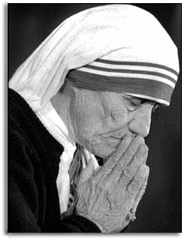
Note: I found this photograph while perusing the web for images of Mother Theresa. Here is the story of the photograph (left) written by the photographer, Peter Canclini.

I traveled to India in early 1993 with a group of Buddhist monks and a good friend who is a student of Tibetan Buddhism. I knew little of Buddhism but I was anxious for adventure and travel. In love with photography since I was first mesmerized by a developing print in high school, I was thrilled at the thought of being able to work in India. This vast and ancient land and its myriad of spiritual traditions have long fascinated me.

From Calcutta through Siliguri, and on up into the Himalayas we traveled. To Sonada Monastery at Darjeeling, then on to Kalimpong and into Sikkim. I separated from our Buddhist group at Rumtek Monastery, near Gangtok, and journeyed on to Peling by jeep. Along the way I photographed with my prism-mounted Rolleiflex and the new Canon Autofocus I purchased for the trip. Accustomed to manual cameras, I had never used autoexposure, let alone autofocus, which the Canon combined with excellent handling and quiet operation. I did not realize how great the camera was until I used it for a while. I soon became a convert.

Later in the trip, I returned to Calcutta, where our group had first landed. Sightseeing around the city I met a young woman who was traveling alone through India. She had a sudden change in her plans and asked if I could deliver some children's clothings to 'Mother House', the compound where Mother Teresa did most of her work. The Missionaries of Charity also operated a house for the dying in Calcutta, as well as a home for orphans. I made my way to 'Mother House'' and knocked on the alley entrance. When a sister answered, I gave her the box of children's clothing and turned back towards the teeming streets of the city.

A moment later a sister touched my sleeve. "Do you want to meet Mother?" she asked. I was stunned. I had never actually expected to the meet the famous Nun of the Calcutta slums. I felt unworthy; but I didn't want to miss such an opportunity. I found myself waiting anxiously on a second-floor balcony. Below, on the courtyard tiles, young sisters quietly washed their cotton saris by hand. The gentle sounds of rinsing and wringing in the open air and the soft murmuring of the sisters began to bring me a sense of calm and beauty. The dignity and peace of the place was like an island of tranquility amidst the chaos and cacophony of Calcutta.

At that moment, Mother Teresa appeared, smiling and surprisingly small! She addressed me in perfect English, "And where are you from?"

In the Bible we are told "by their fruits ye shall know them" and Mother Teresa was proof positive of this great truism. She was a woman whose joy and faith were plain to see. She seemed to radiate an energy and enthusiasm for the service of the Missionaries of Charity and the work of God. She was like a dynamo of love in action.

She spoke warmly, as if she had always known me. At one point she asked, "Are you Catholic?" "Err, uhh," I floundered, "I'm with Alcoholics Anonymous. . ." "Oh," she said. "That's very good. Now, don't you drink anymore, and if you get the desire to drink just send the money you would have spent and we'll give it to the poor!" Yes, Mother, I thought... Another humorous moment came when I asked her if she needed me to photograph for her in the slums of Calcutta. "Oh," she smiled ingenuously, "we have no need for photography; we have the reality!"

"I could have slept in a matchbox that night," as Mark Twain once said.

Meeting Mother Teresa was an amazing blessing in my life, and is a most precious memory. It is fitting that it was something I could never have planned (I discovered later that Mother Teresa and I share the same birthday, August 26th, which just seemed to add another layer of magic to the experience). When our meeting was over that day she said to me, "Now, Mass is at 6 AM; you will be here!" "Yes, Mother, I'll be here..."

I made this photograph the next morning as Mother administered the Eucharist at about 6:40 AM on March 15, 1993. I sincerely hope that this candid view into the daily life of the Missionaries of Charity may bring you some of the serenity that their works have brought to the world.

Thank you, and Bless you,
Peter Canclini


Wednesday, March 28, 2007

Mother Teresa's Speech


This acceptance speech is timeless.
Its message is priceless.
I found this at Catholic Educator's Resources. Enjoy!

Mother Teresa's Nobel Peace Prize Acceptance Speech 1979

Lord, make a channel of Thy peace
that, where there is hatred, I may bring love;
that where there is wrong, I may bring the spirit of
forgiveness;
that, where there is discord, I may bring harmony;
that, where there is error, I may bring truth;
that, where there is doubt, I may bring faith;
that, where there is despair, I may bring hope;
that, where there are shadows, I may bring light;
that, where there is sadness, I may bring joy.
Lord, grant that I may seek rather to comfort than to be comforted,
to understand than to be understood;
to love than to be loved;
for it is by forgetting self that one finds;
it is forgiving that one is forgiven;
it is by dying that one awakens to eternal life.

- St. Francis of Assisi


As we have gathered here together to thank God for the Nobel Peace Prize I think it will be beautiful that we pray the prayer of St. Francis of Assisi which always surprises me very much — we pray this prayer every day after Holy Communion, because it is very fitting for each one of us, and I always wonder that 4-500 years ago as St. Francis of Assisi composed this prayer that they had the same difficulties that we have today, as we compose this prayer that fits very nicely for us also. I think some of you already have got it — so we will pray together.

Let us thank God for the opportunity that we all have together today, for this gift of peace that reminds us that we have been created to live that peace, and Jesus became man to bring that good news to the poor. He being God became man in all things like us except sin, and he proclaimed very clearly that he had come to give the good news. The news was peace to all of good will and this is something that we all want — the peace of heart — and God loved the world so much that he gave his son — it was a giving — it is as much as if to say it hurt God to give, because he loved the world so much that he gave his son, and he gave him to Virgin Mary, and what did she do with him?

As soon as he came in her life — immediately she went in haste to give that good news, and as she came into the house of her cousin, the child — the unborn child — the child in the womb of Elizabeth, leapt with joy. He was that little unborn child, was the first messenger of peace. He recognised the Prince of Peace, he recognised that Christ has come to bring the good news for you and for me. And as if that was not enough — it was not enough to become a man — he died on the cross to show that greater love, and he died for you and for me and for that leper and for that man dying of hunger and that naked person lying in the street not only of Calcutta, but of Africa, and New York, and London, and Oslo — and insisted that we love one another as he loves each one of us. And we read that in the Gospel very clearly — love as I have loved you — as I love you — as the Father has loved me, I love you — and the harder the Father loved him, he gave him to us, and how much we love one another, we, too, must give each other until it hurts. It is not enough for us to say: I love God, but I do not love my neighbour. St. John says you are a liar if you say you love God and you don't love your neighbour. How can you love God whom you do not see, if you do not love your neighbour whom you see, whom you touch, with whom you live. And so this is very important for us to realise that love, to be true, has to hurt. It hurt Jesus to love us, it hurt him. And to make sure we remember his great love he made himself the bread of life to satisfy our hunger for his love. Our hunger for God, because we have been created for that love. We have been created in his image. We have been created to love and be loved, and then he has become man to make it possible for us to love as he loved us. He makes himself the hungry one — the naked one — the homeless one — the sick one — the one in prison — the lonely one — the unwanted one — and he says: You did it to me. Hungry for our love, and this is the hunger of our poor people. This is the hunger that you and I must find, it may be in our own home.

I never forget an opportunity I had in visiting a home where they had all these old parents of sons and daughters who had just put them in an institution and forgotten maybe. And I went there, and I saw in that home they had everything, beautiful things, but everybody was looking towards the door. And I did not see a single one with their smile on their face. And I turned to the Sister and I asked: How is that? How is it that the people they have everything here, why are they all looking towards the door, why are they not smiling? I am so used to see the smile on our people, even the dying one smile, and she said: This is nearly every day, they are expecting, they are hoping that a son or daughter will come to visit them. They are hurt because they are forgotten, and see — this is where love comes. That poverty comes right there in our own home, even neglect to love. Maybe in our own family we have somebody who is feeling lonely, who is feeling sick, who is feeling worried, and these are difficult days for everybody. Are we there, are we there to receive them, is the mother there to receive the child?

I was surprised in the West to see so many young boys and girls given into drugs, and I tried to find out why — why is it like that, and the answer was: Because there is no one in the family to receive them. Father and mother are so busy they have no time. Young parents are in some institution and the child takes back to the street and gets involved in something. We are talking of peace. These are things that break peace, but I feel the greatest destroyer of peace today is abortion, because it is a direct war, a direct killing — direct murder by the mother herself. And we read in the Scripture, for God says very clearly: Even if a mother could forget her child — I will not forget you — I have carved you in the palm of my hand. We are carved in the palm of His hand, so close to Him that unborn child has been carved in the hand of God. And that is what strikes me most, the beginning of that sentence, that even if a mother could forget something impossible — but even if she could forget — I will not forget you. And today the greatest means — the greatest destroyer of peace is abortion. And we who are standing here — our parents wanted us. We would not be here if our parents would do that to us. Our children, we want them, we love them, but what of the millions. Many people are very, very concerned with the children in India, with the children in Africa where quite a number die, maybe of malnutrition, of hunger and so on, but millions are dying deliberately by the will of the mother. And this is what is the greatest destroyer of peace today. Because if a mother can kill her own child — what is left for me to kill you and you kill me — there is nothing between. And this I appeal in India, I appeal everywhere: Let us bring the child back, and this year being the child's year: What have we done for the child? At the beginning of the year I told, I spoke everywhere and I said: Let us make this year that we make every single child born, and unborn, wanted. And today is the end of the year, have we really made the children wanted? I will give you something terrifying. We are fighting abortion by adoption, we have saved thousands of lives, we have sent words to all the clinics, to the hospitals, police stations — please don't destroy the child, we will take the child. So every hour of the day and night it is always somebody, we have quite a number of unwedded mothers — tell them come, we will take care of you, we will take the child from you, and we will get a home for the child. And we have a tremendous demand from families who have no children, that is the blessing of God for us. And also, we are doing another thing which is very beautiful — we are teaching our beggars, our leprosy patients, our slum dwellers, our people of the street, natural family planning.

And in Calcutta alone in six years — it is all in Calcutta — we have had 61,273 babies less from the families who would have had, but because they practise this natural way of abstaining, of self-control, out of love for each other. We teach them the temperature meter which is very beautiful, very simple, and our poor people understand. And you know what they have told me? Our family is healthy, our family is united, and we can have a baby whenever we want. So clear — those people in the street, those beggars — and I think that if our people can do like that how much more you and all the others who can know the ways and means without destroying the life that God has created in us.

The poor people are very great people. They can teach us so many beautiful things. The other day one of them came to thank and said: You people who have vowed chastity you are the best people to teach us family planning. Because it is nothing more than self-control out of love for each other. And I think they said a beautiful sentence. And these are people who maybe have nothing to eat, maybe they have not a home where to live, but they are great people.The poor are very wonderful people. One evening we went out and we picked up four people from the street. And one of them was in a most terrible condition — and I told the Sisters: You take care of the other three, I take of this one that looked worse. So I did for her all that my love can do. I put her in bed, and there was such a beautiful smile on her face. She took hold of my hand, as she said one word only: Thank you — and she died.

I could not help but examine my conscience before her, and I asked what would I say if I was in her place. And my answer was very simple. I would have tried to draw a little attention to myself, I would have said I am hungry, that I am dying, I am cold, I am in pain, or something, but she gave me much more — she gave me her grateful love. And she died with a smile on her face. As that man whom we picked up from the drain, half eaten with worms, and we brought him to the home. I have lived like an animal in the street, but I am going to die like an angel, loved and cared for. And it was so wonderful to see the greatness of that man who could speak like that, who could die like that without blaming anybody, without cursing anybody, without comparing anything. Like an angel — this is the greatness of our people. And that is why we believe what Jesus had said: I was hungry — I was naked — I was homeless — I was unwanted, unloved, uncared for — and you did it to me.

I believe that we are not real social workers. We may be doing social work in the eyes of the people, but we are really contemplatives in the heart of the world. For we are touching the Body of Christ 24 hours. We have 24 hours in this presence, and so you and I. You too try to bring that presence of God in your family, for the family that prays together stays together. And I think that we in our family don't need bombs and guns, to destroy to bring peace — just get together, love one another, bring that peace, that joy, that strength of presence of each other in the home. And we will be able to overcome all the evil that is in the world.

There is so much suffering, so much hatred, so much misery, and we with our prayer, with our sacrifice are beginning at home. Love begins at home, and it is not how much we do, but how much love we put in the action that we do. It is to God Almighty — how much we do it does not matter, because He is infinite, but how much love we put in that action. How much we do to Him in the person that we are serving.

Some time ago in Calcutta we had great difficulty in getting sugar, and I don't know how the word got around to the children, and a little boy of four years old, Hindu boy, went home and told his parents: I will not eat sugar for three days, I will give my sugar to Mother Teresa for her children. After three days his father and mother brought him to our home. I had never met them before, and this little one could scarcely pronounce my name, but he knew exactly what he had come to do. He knew that he wanted to share his love.

And this is why I have received such a lot of love from you all. From the time that I have come here I have simply been surrounded with love, and with real, real understanding love. It could feel as if everyone in India, everyone in Africa is somebody very special to you. And I felt quite at home I was telling Sister today. I feel in the Convent with the Sisters as if I am in Calcutta with my own Sisters. So completely at home here, right here.

And so here I am talking with you — I want you to find the poor here, right in your own home first. And begin love there. Be that good news to your own people. And find out about your next-door neighbour — do you know who they are? I had the most extraordinary experience with a Hindu family who had eight children. A gentleman came to our house and said: Mother Teresa, there is a family with eight children, they had not eaten for so long — do something. So I took some rice and I went there immediately. And I saw the children — their eyes shinning with hunger — I don't know if you have ever seen hunger. But I have seen it very often. And she took the rice, she divided the rice, and she went out. When she came back I asked her — where did you go, what did you do? And she gave me a very simple answer: They are hungry also. What struck me most was that she knew — and who are they, a Muslim family — and she knew. I didn't bring more rice that evening because I wanted them to enjoy the joy of sharing. But there were those children, radiating joy, sharing the joy with their mother because she had the love to give. And you see this is where love begins — at home. And I want you — and I am very grateful for what I have received. It has been a tremendous experience and I go back to India — I will be back by next week, the 15th I hope — and I will be able to bring your love.

And I know well that you have not given from your abundance, but you have given until it has hurt you. Today the little children they have — I was so surprised — there is so much joy for the children that are hungry. That the children like themselves will need love and care and tenderness, like they get so much from their parents. So let us thank God that we have had this opportunity to come to know each other, and this knowledge of each other has brought us very close. And we will be able to help not only the children of India and Africa, but will be able to help the children of the whole world, because as you know our Sisters are all over the world. And with this prize that I have received as a prize of peace, I am going to try to make the home for many people that have no home. Because I believe that love begins at home, and if we can create a home for the poor — I think that more and more love will spread. And we will be able through this understanding love to bring peace, be the good news to the poor. The poor in our own family first, in our country and in the world.

To be able to do this, our Sisters, our lives have to be woven with prayer. They have to be woven with Christ to be able to understand, to be able to share. Because today there is so much suffering — and I feel that the passion of Christ is being relived all over again — are we there to share that passion, to share that suffering of people. Around the world, not only in the poor countries, but I found the poverty of the West so much more difficult to remove. When I pick up a person from the street, hungry, I give him a plate of rice, a piece of bread, I have satisfied. I have removed that hunger. But a person that is shut out, that feels unwanted, unloved, terrified, the person that has been thrown out from society — that poverty is so hurtable and so much, and I find that very difficult. Our Sisters are working amongst that kind of people in the West. So you must pray for us that we may be able to be that good news, but we cannot do that without you, you have to do that here in your country. You must come to know the poor, maybe our people here have material things, everything, but I think that if we all look into our own homes, how difficult we find it sometimes to smile at each, other, and that the smile is the beginning of love.

And so let us always meet each other with a smile, for the smile is the beginning of love, and once we begin to love each other naturally we want to do something. So you pray for our Sisters and for me and for our Brothers, and for our Co-Workers that are around the world. That we may remain faithful to the gift of God, to love Him and serve Him in the poor together with you. What we have done we should not have been able to do if you did not share with your prayers, with your gifts, this continual giving. But I don't want you to give me from your abundance, I want that you give me until it hurts.

The other day I received 15 dollars from a man who has been on his back for twenty years, and the only part that he can move is his right hand. And the only companion that he enjoys is smoking. And he said to me: I do not smoke for one week, and I send you this money. It must have been a terrible sacrifice for him, but see how beautiful, how he shared, and with that money I bought bread and I gave to those who are hungry with a joy on both sides, he was giving and the poor were receiving. This is something that you and I — it is a gift of God to us to be able to share our love with others. And let it be as it was for Jesus. Let us love one another as he loved us. Let us love Him with undivided love. And the joy of loving Him and each other — let us give now — that Christmas is coming so close. Let us keep that joy of loving Jesus in our hearts. And share that joy with all that we come in touch with. And that radiating joy is real, for we have no reason not to be happy because we have no Christ with us. Christ in our hearts, Christ in the poor that we meet, Christ in the smile that we give and the smile that we receive. Let us make that one point: That no child will be unwanted, and also that we meet each other always with a smile, especially when it is difficult to smile.

I never forget some time ago about fourteen professors came from the United States from different universities. And they came to Calcutta to our house. Then we were talking about that they had been to the home for the dying. We have a home for the dying in Calcutta, where we have picked up more than 36,000 people only from the streets of Calcutta, and out of that big number more than 18,000 have died a beautiful death. They have just gone home to God; and they came to our house and we talked of love, of compassion, and then one of them asked me: Say, Mother, please tell us something that we will remember, and I said to them: Smile at each other, make time for each other in your family. Smile at each other. And then another one asked me: Are you married, and I said: Yes, and I find it sometimes very difficult to smile at Jesus because he can be very demanding sometimes. This is really something true, and there is where love comes — when it is demanding, and yet we can give it to Him with joy. Just as I have said today, I have said that if I don't go to Heaven for anything else I will be going to Heaven for all the publicity because it has purified me and sacrificed me and made me really ready to go to Heaven. I think that this is something, that we must live life beautifully, we have Jesus with us and He loves us. If we could only remember that God loves me, and I have an opportunity to love others as he loves me, not in big things, but in small things with great love, then Norway becomes a nest of love. And how beautiful it will be that from here a centre for peace has been given. That from here the joy of life of the unborn child comes out. If you become a burning light in the world of peace, then really the Nobel Peace Prize is a gift of the Norwegian people. God bless you!

ACKNOWLEDGEMENT

Mother Teresa. "Nobel Peace Prize acceptance speech." December 11, 1979 Oslo, Norway.

THE AUTHOR

Mother Teresa of Calcutta (1910 - 1997) was born Agnes Gonxha Bojaxhiu in 1910 in Skopje, Yugoslavia. She joined the Sisters of Loreto in 1928 taking the name “Teresa” after St. Teresa of Lesiux, patroness of Missionaries. In 1948, she came across a half-dead woman lying in front of a Calcutta hospital. She stayed with the woman until she died. From that point on, she dedicated the majority of her life to helping the poorest of the poor in India, thus gaining her the name “Saint of the Gutters.” She founded an order of nuns called the Missionaries of Charity in Calcutta, India dedicated to serving the poor. Almost 50 years later, the Missionaries of Charity have grown from 12 sisters in India to over 4,000 in 517 missions throughout 100 countries worldwide. For over 50 years, she worked selflesssly helping the poor. That devotion towards the poor won her respect throughout the world and the Nobel Peace Prize in 1979.
Blog Widget by LinkWithin